Best Creatine (2026): Monohydrate, Dose, and Timing
On this page
- What creatine does (short version)
- How to choose the best creatine (buying criteria)
- Checklist
- Creatine monohydrate vs other forms
- How much to take (and optional loading)
- Best time to take creatine
- Best creatine powders compared
- Who should skip or ask a doctor first
- Related guides
- Powder vs capsules vs gummies (format)
- FAQ
- Sources
Best Creatine (2026): Monohydrate Picks, Dose, and When to Take It
Disclaimer: This article is for information only and is not medical advice. If you have kidney disease, are pregnant or breastfeeding, take medicines that affect the kidneys, or have another medical condition, talk to a clinician before using creatine. BiohackList does not accept paid or sponsored placements. We may earn commissions from qualifying purchases in the future. See /disclosure.
The best creatine for most healthy adults is plain creatine monohydrate powder at 3 to 5 g per day from a product with third-party testing (for example NSF Certified for Sport, Informed Sport, or a published certificate of analysis). Timing matters far less than taking it every day. A loading phase is optional. Skip fancy forms unless you have a clear reason, and talk to a clinician first if you have kidney disease or are pregnant or breastfeeding.
Looking for the best creatine without wading through dozens of "advanced" formulas? Start with creatine monohydrate, 3 to 5 g daily, and a label you can verify. This hub covers how to choose a powder, when to take it, how loading works, and where women's creatine and gummy formats fit, with links out so those topics stay deep, not duplicated.
No listing on this page is paid or sponsored.
What creatine does (short version)
Your body makes creatine and you also get some from meat and fish. Muscle stores creatine largely as phosphocreatine, which helps regenerate ATP during short, hard efforts such as heavy lifts or sprints.
Paired with resistance training, creatine monohydrate is one of the most replicated ergogenic aids for high-intensity performance and training adaptations in healthy adults. That is the core of the 2017 ISSN position stand. Non-gym uses (cognition, healthy aging framing) are a growing marketing theme. The clinical evidence outside sport is a different, often thinner, literature and is not the focus of this buyer's hub.
Creatine is not a fat burner. It does not "balance hormones." Treat those claims as red flags.
How to choose the best creatine (buying criteria)
- Confirm the form is creatine monohydrate. Micronized powder is the same compound; it usually dissolves more easily.
- Confirm 3 to 5 g creatine per serving, stated as creatine, not buried in a proprietary blend.
- Verify third-party testing: NSF Certified for Sport, Informed Sport or Informed Choice, or a dated certificate of analysis. Check the certifier's own directory when you can, not only a marketplace title that says "NSF."
- Compute cost per 5 g = price ÷ number of 5 g servings in the container.
- Prefer powder for dose per dollar. If you want gummies, use the sibling creatine gummies guide when it is live, and only buy jars with a recent independent result or an NSF listing you can open yourself on nsfsport.com.
- Reject red-flag claims such as "fat burner," "hormone balance," or mysterious "advanced creatine" with no dose on the facts panel.
Checklist
- Label says creatine monohydrate
- 3 to 5 g creatine per serving
- NSF / Informed Sport / COA link or lot look-up
- Cost per 5 g calculated
- No medical red flags for you personally (or a clinician OK'd creatine)
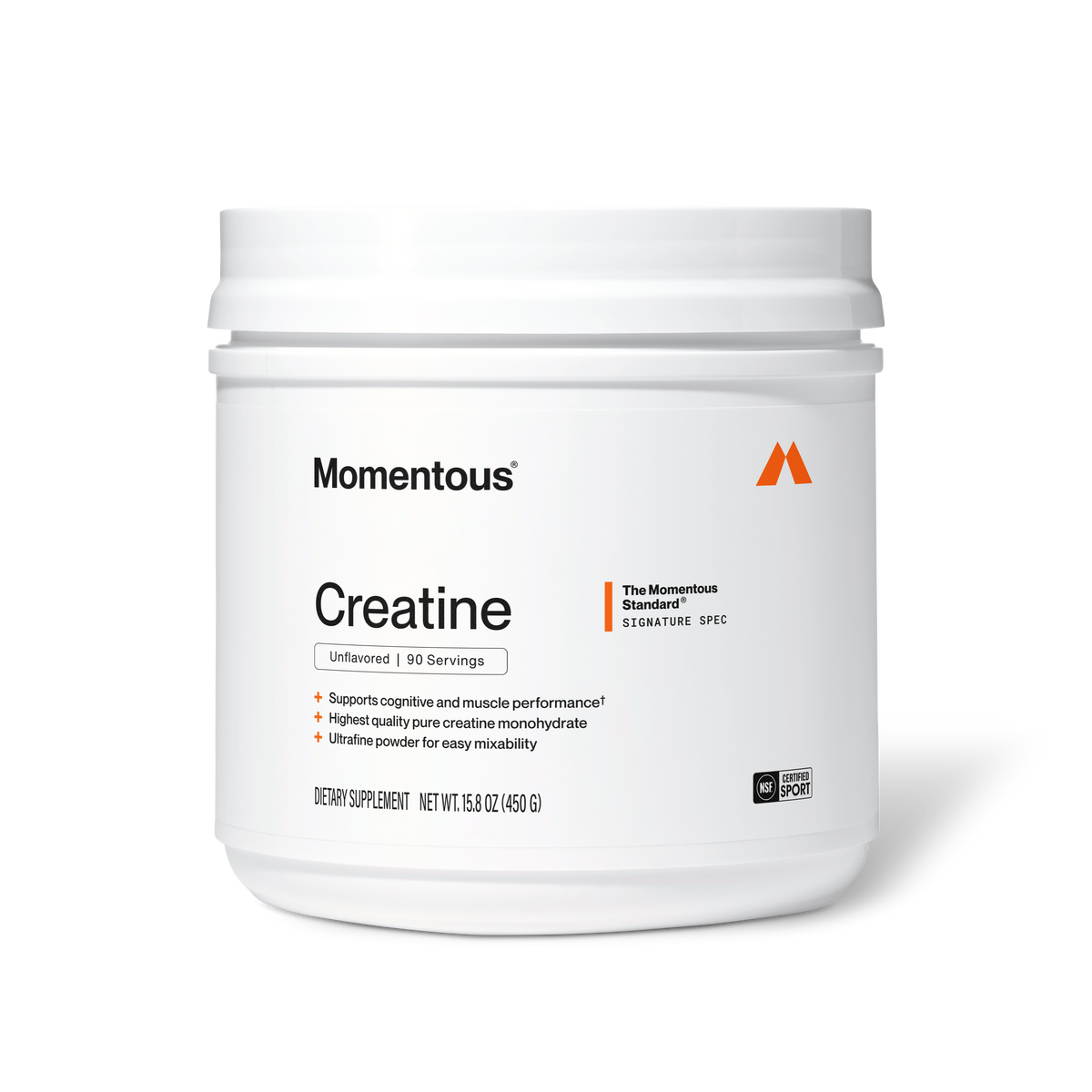
Creapure is a brand name for creatine monohydrate from Alzchem. Seeing Creapure on a label is a raw-material quality signal, not a different molecule. Micronized monohydrate from other makers can still be fine when dose and testing check out. Momentous, for example, states it no longer sources Creapure and instead describes an in-house "Signature Spec" standard; that change does not by itself make the product better or worse than other monohydrate powders with third-party marks you can verify yourself.
Creatine monohydrate vs other forms
Almost all of the human performance and safety literature uses creatine monohydrate. A 2022 critical review by Kreider, Jäger, and Purpura concluded that marketed "novel" forms had not been shown to be a more effective creatine source than monohydrate, and that many were less well studied, more expensive, or both. Article processing charges for selected papers in that Nutrients special issue were funded by Alzchem (a creatine manufacturer). The authors disclose industry consulting and creatine-related patent history.
A 2021 expert Q&A in the Journal of the International Society of Sports Nutrition (Antonio and coauthors) likewise treats monohydrate as the reference form and reports no peer-reviewed evidence that equal amounts of other forms raise muscle creatine more than monohydrate. Several authors disclose ISSN leadership roles and creatine industry relationships.
Buffered creatine, creatine hydrochloride, creatine nitrate, and multi-ingredient "advanced" blends can still contain real creatine. They are not the default pick when your goal is the studied dose at a clear cost per gram. If a blend hides the creatine grams inside a proprietary mix, walk away.
How much to take (and optional loading)
The 2017 ISSN position stand describes two common approaches that still shape practice:
- Maintenance without loading: about 3 g per day builds muscle creatine stores over roughly four weeks (classic protocols often cite 3 g/day for 28 days). Many adults simply use 3 to 5 g daily, including rest days.
- Optional loading: about 0.3 g per kg body weight per day (often about 20 g/day split into several ~5 g doses) for 5 to 7 days, then 3 to 5 g/day to maintain. Some larger athletes use the high end of maintenance, and a few studies discuss up to about 5 to 10 g/day for very large athletes; that is not a casual default.
The 2021 Antonio et al. review states that a loading phase is not required. Loading saturates muscle creatine faster. Daily 3 to 5 g reaches similar stores over about three to four weeks. Split large loading doses across the day; single very large boluses are more likely to upset the gut.
Funding note: The 2017 ISSN position stand lists support from the Council for Responsible Nutrition, a supplement trade group. The 2021 Q&A lists no external grant funding; author conflicts are disclosed in the paper as summarized above.
Best time to take creatine
The best time to take creatine is whenever you won't skip it.
Direct pre- versus post-workout comparisons are few and small. Antonio and Ciccone (2013) randomized recreational male lifters to 5 g immediately before or after training for four weeks. Fat-free mass and bench press improved over time in the sample; the statistical interaction by timing was not significant, though magnitude-based inference leaned slightly toward post-workout. Candow and colleagues and later narrative reviews (including the 2022 "Creatine O'Clock" article and a 2025 Part II misconceptions update) generally conclude that pre- and post-exercise creatine look similarly effective for long-term training adaptations. Consistent daily intake matters more than the clock.
Practical rule: pick a cue you already keep (post-workout shake, morning coffee, evening meal). A small post-workout preference in some analyses doesn't beat a missed dose.
Best creatine powders compared
Prices checked on official brand pages November 6, 2026 (WITA). Sorted by cost per 5 g at regular (non-subscribe) price. We did not lab-test these products. Certification marks below are labeled by how they were checked Nov 6. Recheck prices and directories on publish day.
| Product | Form | Creatine / serving | Third-party mark | Price (checked) | Cost per 5 g | Notes |
|---|---|---|---|---|---|---|
| NOW Creatine Monohydrate Powder (8 oz) | Powder | 5 g | Informed Sport mark on NOW's page only (company-posted certificate image; Informed Sport directory product row not verified Nov 6) | $15.99 regular ($11.99 sale) on nowfoods.com Nov 6 | About $0.36 at regular | About 45 servings; budget monohydrate |
| Momentous Creatine Monohydrate | Micronized powder | 5 g | Brand page states NSF Certified for Sport; matching nsfsport.com listing-detail row not freshly opened Nov 6 | $42.99 one-time on brand page Nov 6 | About $0.48 | 90 servings; schema InStock Nov 6 |
| Thorne Creatine | Powder | 5 g | Brand page states NSF Certified for Sport; matching nsfsport.com listing-detail row not freshly opened Nov 6 | $44 on thorne.com Nov 6 | About $0.49 | 90 servings; schema InStock |
Subscribe-and-save prices change the math. Momentous showed about $32.24 on a subscribe option Nov 6; if you pay that, cost per 5 g falls to about $0.36. Use the price on your receipt.
Larger NOW tubs (21.2 oz and 2.2 lb) lower cost per 5 g further when they are in stock at the sale prices shown on nowfoods.com Nov 6 ($24.74 and $41.24 sale). Confirm serving counts on the label you buy.
For women-specific blends, menopause-related trial evidence, and why "women's creatine" usually costs more per 5 g, see Best Creatine for Women. That spoke uses the same monohydrate-first rule and the same powder listings.
Who should skip or ask a doctor first
Creatine monohydrate at studied doses is among the most researched supplements in healthy adults. The 2017 ISSN stand reports no compelling evidence of harm in healthy people at studied regimens, including longer-term use discussed in that review. Still:
- Kidney disease or reduced kidney function: ask a clinician before use. Creatine can raise serum creatinine, a common lab marker, because creatine breaks down to creatinine. That lab shift is not the same thing as kidney damage, but it can confuse eGFR equations that rely on creatinine alone (Antonio et al. 2021). People with kidney disease need individualized advice, not a blog protocol.
- Pregnancy or breastfeeding: human data are limited; ask a clinician first.
- Medicines that stress the kidneys or other complex conditions: same rule.
This page is not a diagnosis tool and does not replace clinical care.
Related guides
- Best Creatine for Women: women's blends, cost per 5 g, menopause trial evidence
- Best creatine gummies (sibling draft, not live yet): underdosing tests, verification steps, when powder wins
- Creatine without working out: not live on BiohackList yet. The women's article notes that strength and lean-mass results mainly come from trials that pair creatine with training.
Market context only: NutraIngredients (Nov 5, 2026), citing Innova Market Insights, reported creatine product launches up 62% year over year for January to August 2026 versus the same period a year earlier, and creatine-plus-bioactive launches up 134% YoY, with quality talk rising after public gummy underdosing coverage. That is market reporting, not a clinical finding.
Powder vs capsules vs gummies (format)
Powder wins on cost per verified gram and on shelf stability in dry form. Capsules are convenient but often need several pills to reach 5 g. Gummies only work if the serving truly holds the labeled creatine; public lab compilations found many underdosed batches. Details and a verification checklist belong in the sibling creatine gummies draft (not live yet). Until that spoke is live, use the powder table above or wait for a jar with a dated independent report you can open.
If you already bought gummies, count how many pieces equal 5 g on the Supplement Facts panel. If the math or the testing fails, switch to monohydrate powder rather than stacking more candy.
FAQ
What is the best creatine to take? Plain creatine monohydrate powder, 3 to 5 g daily, with third-party testing. Other forms are not shown to outperform monohydrate for strength or lean mass in healthy adults.
When is the best time to take creatine? Whenever you will take it every day. Consistency builds muscle stores; a slight post-workout preference in some studies does not beat a missed dose.
Do I need to load creatine? No. Loading (about 20 g/day split for 5 to 7 days) saturates faster; 3 to 5 g daily reaches similar stores in about three to four weeks.
How much creatine should I take per day? Most adults use 3 to 5 g of creatine monohydrate daily, including rest days. Larger athletes sometimes use the high end; ask a clinician if unsure.
Is creatine safe every day? For healthy adults at 3 to 5 g/day, creatine monohydrate is among the most studied supplements. People with kidney disease, or who are pregnant or breastfeeding, should ask a doctor first.
Disclaimer: This article is for information only and is not medical advice. If you have kidney disease, are pregnant or breastfeeding, take medicines that affect the kidneys, or have another medical condition, talk to a clinician before using creatine. BiohackList does not accept paid or sponsored placements. We may earn commissions from qualifying purchases in the future. See /disclosure.
Sources
- Kreider RB, Kalman DS, Antonio J, et al. International Society of Sports Nutrition position stand: safety and efficacy of creatine supplementation in exercise, sport, and medicine. J Int Soc Sports Nutr. 2017;14:18. PMID 28615996. Funding listed: Council for Responsible Nutrition. https://pmc.ncbi.nlm.nih.gov/articles/PMC5469049/
- Antonio J, Candow DG, Forbes SC, et al. Common questions and misconceptions about creatine supplementation. J Int Soc Sports Nutr. 2021;18:13. PMID 33557850. Authors disclose ISSN and creatine industry relationships. https://pmc.ncbi.nlm.nih.gov/articles/PMC7871530/
- Kreider RB, Jäger R, Purpura M. Bioavailability, efficacy, safety, and regulatory status of creatine and related compounds: a critical review. Nutrients. 2022;14(5):1035. PMID 35268011. APC funding: Alzchem; author conflicts disclosed. https://pmc.ncbi.nlm.nih.gov/articles/PMC8912867/
- Candow DG, Forbes SC, Roberts BM, et al. Creatine O'Clock: does timing of ingestion really influence muscle mass and performance? Front Sports Act Living. 2022. https://www.frontiersin.org/journals/sports-and-active-living/articles/10.3389/fspor.2022.893714/full
- Antonio J, Ciccone V. The effects of pre versus post workout supplementation of creatine monohydrate on body composition and strength. J Int Soc Sports Nutr. 2013;10:36. PMID 23919405. https://pubmed.ncbi.nlm.nih.gov/23919405/
- NutraIngredients. Premium creatine in prime position amidst longevity boom. Nov 5, 2026. Innova Market Insights launch figures as reported by NutraIngredients. https://www.nutraingredients.com/Article/2026/11/05/premium-creatine-in-prime-position-amidst-longevity-boom/
- Thorne Creatine product page (price and 5 g serving). https://www.thorne.com/products/dp/creatine
- Momentous Creatine Monohydrate product page. https://www.livemomentous.com/products/creatine-monohydrate
- NOW Creatine Monohydrate Powder product page. https://www.nowfoods.com/products/sports-nutrition/creatine-monohydrate-powder
- BiohackList: Best Creatine for Women. https://www.biohacklist.com/blog/best-creatine-for-women
- BiohackList disclosure. https://www.biohacklist.com/disclosure
FAQ
What is the best creatine to take?
Plain creatine monohydrate powder, 3 to 5 g daily, with third-party testing. Other forms are not shown to outperform monohydrate for strength or lean mass in healthy adults.
When is the best time to take creatine?
Whenever you will take it every day. Consistency builds muscle stores; a slight post-workout preference in some studies does not beat a missed dose.
Do I need to load creatine?
No. Loading (about 20 g/day split for 5 to 7 days) saturates faster; 3 to 5 g daily reaches similar stores in about three to four weeks.
How much creatine should I take per day?
Most adults use 3 to 5 g of creatine monohydrate daily, including rest days. Larger athletes sometimes use the high end; ask a clinician if unsure.
Is creatine safe every day?
For healthy adults at 3 to 5 g/day, creatine monohydrate is among the most studied supplements. People with kidney disease, or who are pregnant or breastfeeding, should ask a doctor first.
Products in this article
Supplements
Momentous Creatine Monohydrate
Momentous
Creatine monohydrate powder dietary supplement from Momentous.
Supplements
Thorne Creatine
Thorne
Micronized creatine monohydrate powder sold as a dietary supplement by Thorne.
Supplements
NOW Creatine Monohydrate
NOW Foods
Creatine monohydrate powder dietary supplement from NOW Foods.