Best Creatine for Women (2026): What to Buy and Why
On this page
- Creatine for women: what it does (and doesn't)
- What the research shows: evidence check
- How much creatine should women take?
- How to choose a creatine: buying criteria
- Best creatine for women compared
- Women's creatine blends: what the add-ins do
- Peptide blends (PeptiStrong)
- Greens and vitamin blends
- Creatine gummies: the testing problem
- Is creatine safe for women?
- FAQ
- What is the best creatine for women?
- How much creatine should a woman take?
- Is creatine safe for women?
- Does creatine make women gain weight or bloat?
- Is creatine good for women over 50 or after menopause?
- Do creatine gummies work?
- Is creatine monohydrate better than creatine HCl or other forms?
- Does creatine work without working out?
- Sources
Disclaimer: This article is for information only and is not medical advice. If you have a medical condition, are pregnant or breastfeeding, or take medication, talk to your doctor before taking creatine. BiohackList does not accept paid or sponsored placements; products here are chosen on published dose, testing and price. We may earn commissions from qualifying purchases in the future.
The best creatine for most women is plain creatine monohydrate, 3 to 5 g a day, from a brand with third-party testing. The new "women's" creatine products use the same creatine monohydrate and add other ingredients. Those extras raise the cost per 5 g dose about 2.7 to 5.4 times in our comparison, and they have far less research behind them.
In 30 seconds
- Plain creatine monohydrate is the form used in almost all of the research. It costs about $0.36 to $0.49 per 5 g from the tested powders below.
- Women's blends add peptides, greens or vitamins. They cost about $1.67 to $1.93 per 5 g at list price, and no trial has tested the blends themselves.
- The clearest results come when creatine is paired with resistance training.
- Many creatine gummies tested short of their label. Powder is the safer bet.
No listing on this page is paid or sponsored.
Creatine for women: what it does (and doesn't)
Your body makes creatine and also gets it from meat and fish. Muscle stores it as phosphocreatine, which helps fuel short, hard efforts such as lifting.
What it does. Paired with resistance training, creatine adds a small amount of extra strength, and in some analyses lean mass, compared with training alone. That's the best-supported effect, and it holds in women, including after menopause.
What is still early. A 2025 narrative review of creatine in women's health says creatine "may improve mood and cognitive function" and that data on perimenopausal women remain limited.
What it doesn't do. Creatine is not a fat burner, and it does not "balance hormones." No study we found supports either claim.
What the research shows: evidence check
| Source | Design | What it found | What it doesn't show |
|---|---|---|---|
| ISSN position stand on female athletes (Sims et al., 2023) | Expert position stand | Recommends 3 to 5 g a day; notes benefits for postmenopausal women at higher doses | Not a new trial; summarizes existing studies |
| Creatine in women's health (Smith-Ryan et al., 2025) | Narrative review | Benefits for strength, performance and body composition, mainly with resistance training; mood and cognition promising | No pooled numbers; perimenopause data limited |
| Creatine in postmenopausal women (Naddafha et al., 2026) | Systematic review and meta-analysis, 7 trials, 608 women | Lean mass up about 0.37 kg and leg press up about 7.5 kg versus placebo; benefits seen with 5 g a day or more plus training | Bone density unchanged overall; trials at 3 g a day or less without training showed no effect; most trials had "some concerns" for bias |
| Creatine plus training in older women (Dos Santos et al., 2021) | Systematic review and meta-analysis, 10 trials, 211 women | Upper-body strength improved; upper- and lower-body strength improved in studies of 24 weeks or longer | No significant effect on muscle mass overall |
Who funded these: Sims 2023 reported no funding or conflicts; Dos Santos 2021 and Naddafha 2026, no external funding. The Council for Responsible Nutrition, a supplement industry group, supported the 2017 position stand. Alzchem, a creatine maker, paid publishing costs for Smith-Ryan 2025 and part of Naddafha 2026. Several authors disclose ties to creatine sellers. Some authors also hold leadership roles at the International Society of Sports Nutrition (ISSN), which published several of these papers.
Our grade: B for strength when paired with resistance training. C for lean mass, because the 2026 meta-analysis found a small gain but the 2021 meta-analysis in older women found no significant effect on muscle mass overall. C for mood, cognition and other benefits outside the gym.
What the evidence does not show:
- That women's blends work better than plain monohydrate. No published trial has compared them.
- That creatine improves bone density. The 2026 meta-analysis found no overall change.
- That creatine alone, without training, builds meaningful muscle in women.
- Long-term effects in pregnancy, or any direct trial in perimenopause.
The measured effects are small: about 0.37 kg of lean mass is real but modest.
How much creatine should women take?
- Daily dose: 3 to 5 g of creatine monohydrate. This is the range in the ISSN 2023 position stand on female athletes.
- Loading is optional. A loading phase, such as about 0.3 g per kg of body weight a day for 5 to 7 days (around 20 g a day for someone who weighs about 67 kg, or 150 lb), fills muscle stores sooner. A 2021 review by creatine researchers in the ISSN's journal concluded that a loading phase "is not required"; 3 to 5 g a day gets you to the same place over a few weeks.
- Timing matters little. Take it at a time you'll remember. Daily consistency matters more than before or after a workout.
- After menopause: the 2026 meta-analysis saw benefits mainly at 5 g a day or more combined with resistance training.
How to choose a creatine: buying criteria
- Form: creatine monohydrate. Micronized versions dissolve more easily. It's the same compound.
- Dose per serving: 3 to 5 g of creatine, stated as creatine, not hidden inside a "blend."
- Third-party testing: look for NSF Certified for Sport, Informed Sport or Informed Choice, or a published certificate of analysis. Check the certifier's own database, not just the label.
- Cost per 5 g: divide the price by the number of 5 g servings.
- Format: powder is cheapest. Capsules often need several per dose. Gummies need proof of content (see below).
- Red flags: a "proprietary blend" with no creatine amount, or claims about "fat burning" or "hormone balancing."
Best creatine for women compared
Prices checked on official pages October 30, 2026; Momentous and HUM checked again October 31, 2026. Sorted by cost per 5 g at regular price.
| Product | Type | Price | Servings (5 g creatine) | Cost per 5 g | Testing |
|---|---|---|---|---|---|
| NOW Creatine Monohydrate Powder, 8 oz | Plain monohydrate powder | $15.99 regular ($11.99 sale seen) | About 45 | About $0.36 | Informed Sport mark shown on NOW's product page (company-reported; not checked in the Informed Sport database) |
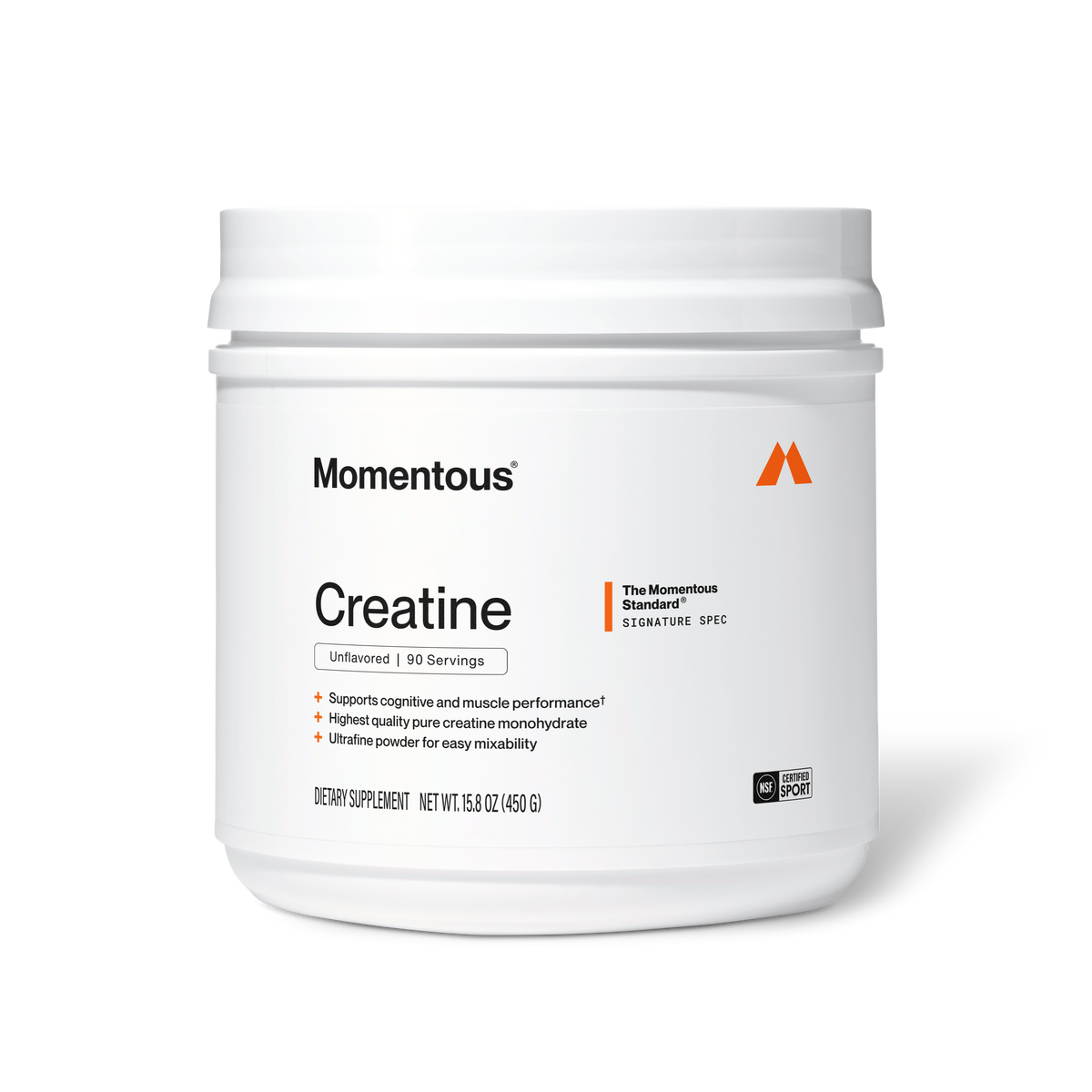
| Momentous Creatine | Plain micronized monohydrate powder | $42.99 (in stock Oct 31, 2026) | 90 | About $0.48 | NSF Certified for Sport (confirmed on nsfsport.com) |
| Thorne Creatine | Plain monohydrate powder | $44 | 90 | About $0.49 | NSF Certified for Sport (confirmed on nsfsport.com) |
| HUM Stack & Sculpt | Women's blend: 5 g monohydrate plus 2.4 g PeptiStrong (fava bean peptides) | $49.99 list ($34.99 sale shown Oct 31, 2026) | 30 | About $1.67 | Clean Label Project certification (company-reported) |
| Ritual Creatine Greens | Women-targeted blend: 5 g micronized monohydrate (Creavitalis) plus greens, spirulina, chlorella, B6, B12, chromium, vitamin C, zinc | $58 regular ($46.40 sale seen) | 30 | About $1.93 | NSF/ANSI 173 dietary supplement certification (confirmed in NSF's listing); Clean Label Project (company-reported) |
Best value: NOW's powder, the lowest cost per 5 g we found. Best documented testing: Thorne and Momentous, both in NSF's Certified for Sport directory.
Women's creatine blends: what the add-ins do
Both blends deliver 5 g of creatine monohydrate, the same as plain powder.
Peptide blends (PeptiStrong)
PeptiStrong is a fava bean protein hydrolysate made by Nuritas, an Irish company. Two human trials are cited on the HUM product page:
- Kerr et al., Nutrients 2023. 30 healthy men took 2.4 g a day or placebo. Strength recovery over 72 hours after hard exercise was better with the peptide, though not at individual time points. The study was funded by Nuritas, and several authors were Nuritas employees.
- Mohan et al., BMJ Nutrition, Prevention & Health 2025. 72 healthy adults aged 19 to 40 did 56 days of resistance training with the peptide or placebo. Leg strength rose more with the peptide (p = 0.05 at day 56). All authors were Nuritas employees, Nuritas funded the study, and Nuritas was responsible for the design, analysis and decision to publish.
Neither trial combined the peptide with creatine, and neither studied women over 40. HUM's own page says its claims are "based on published studies of each ingredient at these doses, not of this combination."
Greens and vitamin blends
Ritual's blend adds leafy greens, spirulina and chlorella, plus 20% of the daily value of several vitamins and minerals (brand-stated). We found no trial of this blend, and none showing these add-ins improve creatine's effect.
Creatine gummies: the testing problem
Creatine gummies are popular, but their content has a poor track record.
Fine Print Nutrition, an independent review site, compiled 29 published lab results for 25 gummy brands from three testers: a supplement maker's in-house lab (NOW Foods, 2024), a supplement app using an outside lab (SuppCo, 2025), and an independent tester who sent samples to Eurofins (2025). In that compilation:
- 15 of 25 brands had at least one batch below 90% of the creatine on the label.
- 13 of 25 had a batch with almost none.
- 10 of 25 met their label in every batch tested.
These tests were not peer reviewed, each covers a single batch, and two of the three testers have commercial interests in supplements.
One likely reason: creatine breaks down into creatinine in water, especially with heat and acid. Dry powder is very stable, per the 2021 ISSN review.
If you want gummies anyway, look up the exact product in NSF's Certified for Sport directory or ask for a dated batch lab report.
Is creatine safe for women?
For healthy adults, the safety record is strong. The 2017 ISSN position stand reports that short- and long-term use, up to 30 g a day for 5 years, has been well tolerated in healthy people. The 2026 postmenopausal meta-analysis found adverse events were mild and similar to placebo, with no change in kidney measures.
Water weight. The one side effect reported consistently is weight gain, mostly water. The ISSN describes short-term fluid retention of about 0.5 to 1.0 liters during high-dose loading.
The blood test issue. Creatine can raise blood creatinine, a lab marker doctors use to estimate kidney function. The 2021 ISSN review explains that this rise does not necessarily mean kidney function has dropped, and that more than 20 years of research has found no harm to kidney health at recommended doses. Tell your doctor you take creatine before blood work.
Talk to a doctor first if you:
- Have kidney disease or reduced kidney function.
- Are pregnant or breastfeeding. We found no completed trials of creatine supplements in pregnant women.
- Take medicines that can affect the kidneys.
More on building a basic supplement routine: the best biohacking products we track.
FAQ
What is the best creatine for women?
For most women, plain creatine monohydrate from a brand with third-party testing is the best choice. It is the form used in almost all of the research. Products marketed to women use the same creatine monohydrate and add other ingredients that raise the price and have much less evidence behind them.
How much creatine should a woman take?
The usual dose is 3 to 5 g a day, the range the International Society of Sports Nutrition gives in its 2023 position stand on female athletes. A loading phase of about 20 g a day for a week (for a body weight of about 67 kg, or 150 lb) fills muscle stores faster, but a 2021 expert review concluded it is not required.
Is creatine safe for women?
In healthy adults, creatine monohydrate at recommended doses is one of the most studied supplements, and reviews have not found harm to kidney health. Talk to a doctor first if you have kidney disease, are pregnant or breastfeeding, or take medicines that affect the kidneys.
Does creatine make women gain weight or bloat?
Some people gain a little weight in the first days, mostly water drawn into muscle. The 2017 ISSN position stand describes short-term fluid retention of about 0.5 to 1.0 liters during high-dose loading. A lower daily dose without loading tends to make this less noticeable.
Is creatine good for women over 50 or after menopause?
A 2026 meta-analysis of seven trials in postmenopausal women found small gains in lean mass (about 0.37 kg) and leg-press strength (about 7.5 kg) versus placebo, mainly when 5 g a day or more was combined with resistance training. Bone density did not change overall.
Do creatine gummies work?
Only if they contain the creatine on the label. In a compilation of lab results from three testers covering 25 gummy brands, 15 had a batch below 90 percent of the labeled creatine, and 13 had a batch with almost none.
Is creatine monohydrate better than creatine HCl or other forms?
Monohydrate is the form studied in most trials. A 2021 review by creatine researchers found no peer-reviewed evidence that equal amounts of other forms, including creatine salts, raise muscle creatine more than monohydrate does.
Does creatine work without working out?
The strength and lean mass results come mainly from trials that paired creatine with resistance training. In the 2026 postmenopausal meta-analysis, trials using 3 g a day or less without training showed no measurable effect.
Disclaimer: This article is for information only and is not medical advice. If you have a medical condition, are pregnant or breastfeeding, or take medication, talk to your doctor before taking creatine. BiohackList does not accept paid or sponsored placements; products here are chosen on published dose, testing and price. We may earn commissions from qualifying purchases in the future.
Affiliate note: There are no affiliate links on this page at launch. No listing is paid or sponsored. See our disclosure.
How we researched this: We read the studies and official pages listed below and checked NSF's Certified for Sport and NSF/ANSI 173 listings. We didn't lab-test these products.
Last checked: Oct 30, 2026.
Sources
- Sims ST et al. ISSN position stand: nutritional concerns of the female athlete, J Int Soc Sports Nutr 2023 (PMID 37221858)
- Smith-Ryan AE et al. Creatine in women's health: bridging the gap from menstruation through pregnancy to menopause, J Int Soc Sports Nutr 2025 (PMID 40371844)
- Naddafha S, Antonio J, Kreider RB, Stout JR. Creatine monohydrate for lean mass, strength, and bone density in postmenopausal women: systematic review and meta-analysis, J Int Soc Sports Nutr 2026 (PMID 42141930)
- Dos Santos EEP et al. Creatine plus resistance training in older females: systematic review and meta-analysis, Nutrients 2021 (PMID 34836013)
- Kreider RB et al. ISSN position stand: safety and efficacy of creatine supplementation, J Int Soc Sports Nutr 2017 (PMID 28615996)
- Antonio J et al. Common questions and misconceptions about creatine supplementation, J Int Soc Sports Nutr 2021 (PMID 33557850)
- Kerr A et al. Vicia faba hydrolysate and strength recovery in healthy men, Nutrients 2023 (PMID 36839344; funded by Nuritas)
- Mohan NM et al. Vicia faba protein hydrolysate with resistance training, BMJ Nutr Prev Health 2025 (PMID 40771513; funded by Nuritas, all authors Nuritas employees)
- Fine Print Nutrition. Do creatine gummies actually have creatine? (Oct 22, 2026; compilation of third-party tests, not peer reviewed)
- NSF Certified for Sport product directory (searched Oct 30, 2026)
- NSF. NSF/ANSI 173 dietary supplement listings, Ritual (current Oct 30, 2026; lists Creatine Greens)
- Thorne. Creatine, 90 servings
- Momentous. Creatine, 90 servings
- NOW Foods. Creatine Monohydrate Powder
- HUM Nutrition. Stack & Sculpt Peptides + Creatine
- HUM Nutrition press release, Aug 27, 2026 (30-day supply)
- Ritual. Creatine Greens
FAQ
What is the best creatine for women?
For most women, plain creatine monohydrate from a brand with third-party testing is the best choice. It is the form used in almost all of the research. Products marketed to women use the same creatine monohydrate and add other ingredients that raise the price and have much less evidence behind them.
How much creatine should a woman take?
The usual dose is 3 to 5 g a day, the range the International Society of Sports Nutrition gives in its 2023 position stand on female athletes. A loading phase of about 20 g a day for a week (for a body weight of about 67 kg, or 150 lb) fills muscle stores faster, but a 2021 expert review concluded it is not required.
Is creatine safe for women?
In healthy adults, creatine monohydrate at recommended doses is one of the most studied supplements, and reviews have not found harm to kidney health. Talk to a doctor first if you have kidney disease, are pregnant or breastfeeding, or take medicines that affect the kidneys.
Does creatine make women gain weight or bloat?
Some people gain a little weight in the first days, mostly water drawn into muscle. The 2017 ISSN position stand describes short-term fluid retention of about 0.5 to 1.0 liters during high-dose loading. A lower daily dose without loading tends to make this less noticeable.
Is creatine good for women over 50 or after menopause?
A 2026 meta-analysis of seven trials in postmenopausal women found small gains in lean mass (about 0.37 kg) and leg-press strength (about 7.5 kg) versus placebo, mainly when 5 g a day or more was combined with resistance training. Bone density did not change overall.
Do creatine gummies work?
Only if they contain the creatine on the label. In a compilation of lab results from three testers covering 25 gummy brands, 15 had a batch below 90 percent of the labeled creatine, and 13 had a batch with almost none.
Is creatine monohydrate better than creatine HCl or other forms?
Monohydrate is the form studied in most trials. A 2021 review by creatine researchers found no peer-reviewed evidence that equal amounts of other forms, including creatine salts, raise muscle creatine more than monohydrate does.
Does creatine work without working out?
The strength and lean mass results come mainly from trials that paired creatine with resistance training. In the 2026 postmenopausal meta-analysis, trials using 3 g a day or less without training showed no measurable effect.
Products in this article
Supplements
Thorne Creatine
Thorne
Micronized creatine monohydrate powder sold as a dietary supplement by Thorne.
Supplements
Momentous Creatine Monohydrate
Momentous
Creatine monohydrate powder dietary supplement from Momentous.
Supplements
NOW Creatine Monohydrate
NOW Foods
Creatine monohydrate powder dietary supplement from NOW Foods.