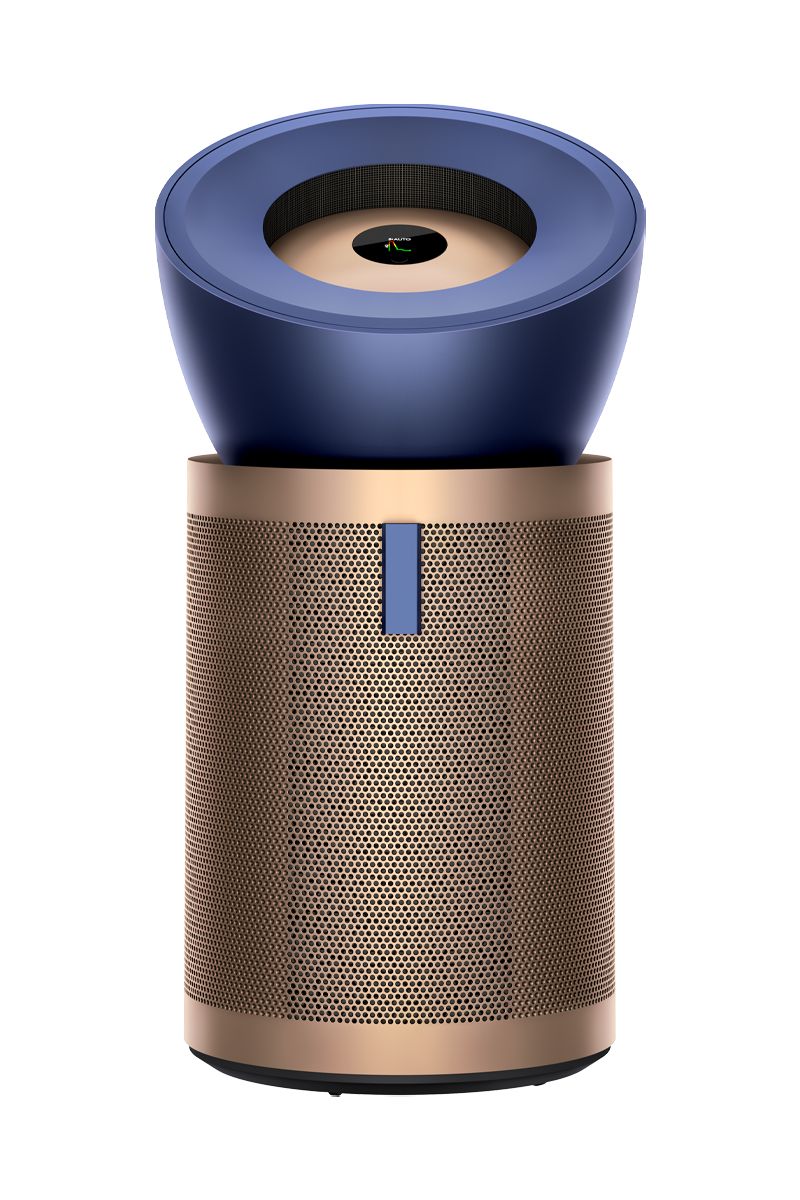
Dyson Air Purifier Review (2026): Purifier Cool, Hot+Cool, Big+Quiet and HushJet vs Coway, Levoit, Blueair and Xiaomi
· BiohackList Editorial
Disclaimer: This article is for information only and is not medical advice. Air purifiers aren't medical devices and aren't a treatment for asthma, allergies or any condition. If you have a respiratory condition, follow your clinician's advice. Prices and specs change; check the retailer before buying. BiohackList may earn commissions from qualifying purchases in the future.
Verdict in 30 seconds: Dyson purifiers work, but on the only comparable figures (for the TP07), they deliver less clean air per dollar than Coway, Levoit or Blueair, and Dyson doesn't publish the standard CADR. Buy one if you want a fan or heater that also purifies, or Dyson's app and design. If you only want cleaner bedroom air, CADR-rated purifiers from about $85 to $350 list more clean air per dollar.
Dyson's 2026 US range starts at $299.99 for the HushJet Compact and runs to $909.99 for the Big+Quiet BP04 (sale prices, checked Oct 4, 2026). The only independent lab numbers we could verify are for two Dyson models: the Purifier Cool TP07, now out of stock, and the Big+Quiet BP06. Both show that Dyson's cleaning rate is ordinary for the money. On top, you get a fan (and on Hot+Cool models a heater), a sealed filter housing, an app and sensors.
We didn't test these purifiers ourselves. Everything below comes from official product pages, the EPA, CARB, ENERGY STAR data and published independent tests, all checked on Oct 4, 2026 (PT).
Dyson's 2026 air purifier lineup
Dyson sells three kinds of purifier in the US: purifying fans (Purifier Cool), purifying fan heaters (Hot+Cool), and dedicated purifiers (Big+Quiet and the new HushJet Compact). All carry a 2-year limited warranty, and dyson.com offers a price-match promise and 30-day returns.
| Model | Type | Price on dyson.com (Oct 4, 2026) | Filter and replacement | Notes |
|---|---|---|---|---|
| Purifier Cool PC1 | Purifier + fan | $399.99 sale (was $549.99), Black/Nickel; White/Silver $549.99, out of stock | 360° Glass HEPA + activated carbon (965432-01), $79.99, every 12 months | Entry model; HEPA H13 per Dyson |
| Purifier Cool PC2 De-NOx | Purifier + fan | $699.99 sale (was $849.99) | Combined HEPA + K-Carbon, 1-year life (price not shown on Oct 4) | Dyson claims "50% more NO₂" captured and continuous formaldehyde destruction; 41.3 in tall |
| Purifier Hot+Cool HP1 | Purifier + fan + heater | $499.99 sale (was $659.99) | Combined Glass HEPA + activated carbon | Dyson lists 63 dB sound level; 11.7 lb |
| Purifier Hot+Cool HP2 De-NOx | Purifier + fan + heater | $699.99 sale (was $949.99) | HEPA + K-Carbon (974527-01), $89.99, 1-year life (out of stock on Oct 4) | Same NO₂ and formaldehyde claims as PC2 |
| Big+Quiet Formaldehyde BP03 / BP04 | Large-room purifier | BP03 $899.99 (was $1,099.99); BP04 $909.99 (was $1,199.99) | H13 HEPA $169.99, every 5 years; K-Carbon $109.99, every 2 years | Dyson claims air projection "over 32 feet"; BP04 adds a CO₂ sensor; 26.24 lb |
| HushJet Compact | Compact purifier | $299.99 sale (was $349.99) | Electrostatic filter, "5-year filter life" per Dyson (replacement price not shown) | Dyson: rooms up to 203 sq ft, 24 dB in Sleep mode, 41 dB at maximum; CARB: Mechanical (SP01-A) |
| Purifier Cool TP07 (reference) | Purifier + fan | $649.99, out of stock | 360° HEPA + carbon | The most independently tested Dyson; used as the benchmark below |
All sale prices were checked on Oct 4, 2026 and have no stated end date. Dyson's 5-year HushJet filter figure comes from a Chinese standard test (GB/T 18801-2022) to a 50% fall in CADR at 12 hours a day, so real life depends on how dirty your air is.
⚠ Recheck at publish: every Dyson sale price above. Prices moved while we researched.
How well do Dyson purifiers actually clean the air?
Probably well enough to help in a small room, but less per dollar than CADR-rated rivals. Independent tests of the TP07 put it slightly behind a Levoit Core 300 that costs about an eighth as much at today's prices ($84.97 vs the TP07's last listed $649.99).
Why Dyson doesn't publish CADR
CADR (clean air delivery rate) is the US standard measure of how much filtered air a purifier delivers, in cubic feet per minute. The EPA tells buyers to choose a CADR big enough for the room. Dyson doesn't list CADR on its US pages. Its stated reason is that CADR tests "do not consider intelligent sensing nor full-room projection", and it uses its own POLAR test in an 81 m³ chamber with nine sensors instead. In a 2021 update to a Smart Air review, Dyson told the publication: "We simply don't engineer purifiers to perform well at this test." Smart Air sells its own purifiers, so read its verdict with that in mind, but the quote is Dyson's.
The catch is that Dyson's own test can't be compared with anyone else's, so we looked for independent and certificate-based numbers.
What independent tests found
- Purifier Cool TP07 (HouseFresh, updated Dec 17, 2025): an estimated PM1 CADR of 94 cfm at top speed and 58 cfm at settings under 45 dBA. HouseFresh also reports an AHAM dust CADR of 89.8 cfm from the TP07's ENERGY STAR certificate. In its 728 cu ft test room the TP07 took 62 minutes to clear the air, against 54 minutes for the Levoit Core 300 ($99.99 list).
- Big+Quiet BP06 (HouseFresh, Dec 17, 2025): the simpler sibling of the BP03 and BP04, without app or sensors. It reached PM1 zero in 30 minutes in the same room, for an estimated PM1 CADR of 198 cfm, close to its AHAM dust CADR of 190.8 cfm. At its quietest setting (40.4 dBA) HouseFresh estimated 128 cfm.
- Purifier Cool TP05 (Smart Air): a particle CADR of 164 m³/h (about 97 cfm), found on Dyson's Chinese store, where CADR disclosure is required.
- CBC Marketplace (Feb 2021): the Dysons it tested averaged about 140 m³/h CADR, lower than most others in that test.
We found no public independent CADR for the PC1, PC2, HP1, HP2, BP03, BP04 or HushJet. No Dyson model appears in the current ENERGY STAR Room Air Cleaners V3.0 list (checked Oct 4, 2026), so there's no certificate number for the current range either.
Formaldehyde and NO₂ claims
The PC2, HP2, BP03 and BP04 carry Dyson's strongest gas claims. Dyson says the K-Carbon filter, impregnated with potassium carbonate, adsorbs "50% more nitrogen dioxide" (PC2/HP2) or "three times more NO₂" (Big+Quiet), and that a catalytic filter "continuously destroys formaldehyde", based on third-party testing to China's GB/T 18801-2022 method. These are brand claims against Dyson's own comparison baseline. We found no independent test that confirms them, so treat them as unverified. The EPA notes that the CADR system covers particles only, and that removing gases needs a sorbent such as activated carbon.
Noise: are Dysons quiet enough for a bedroom?
Yes at low settings, but at the cost of much of the cleaning power. HouseFresh measured the TP07 at 38.9 dB on speed 1 and 56 dB on speed 4 from 3 ft. Its cleaning rate under 45 dBA was 58 cfm, which suits a small bedroom at best. The BP06 measured 40.4 to 51.4 dBA.
Dyson's own figures are lower for its newest model: 24 dB in Sleep mode and 41 dB at maximum for the HushJet Compact. Those numbers come from Dyson, not an independent lab. For comparison, AHAM-rated rivals list 22 to 24 dB at their lowest settings (Levoit Core 300S, Core 300, Coway Mighty), with the same caveat that brand noise figures are measured by the brand.
Running costs: filters and electricity over 5 years
Dyson's filters cost more each, but the Big+Quiet and HushJet stretch replacement intervals. Using list prices on Oct 4, 2026 and each brand's stated interval (first filter included in the box):
| Model | Filter price | Interval (brand) | Approx. filters over 5 years |
|---|---|---|---|
| Dyson PC1 | $79.99 | 12 months | $319.96 (4 replacements) |
| Dyson HP2 | $89.99 | 12 months | $359.96 (4 replacements) |
| Dyson BP03/BP04 | K-Carbon $109.99; HEPA $169.99 | 2 years; 5 years | $219.98 for two K-Carbon swaps, plus $169.99 for the HEPA at year 5 |
| Dyson HushJet Compact | Not shown | "5-year filter life" | Unknown |
| Coway Mighty | $59.79 (Fresh Starter set) | HEPA 1 year; deodorization filter 6 months | $239.16 for four sets, more if you swap the deodorization filter at 6 months |
| Levoit Core 300 | $29.99 | 6 to 8 months | $209.93 to $269.91 |
| Blueair 211i Max | $69.99 | 9-month default subscription | $419.94 (6 replacements) |
Electricity costs little next to filters. HouseFresh measured the TP07 at 3.5 W on speed 1 and 28.9 W on speed 5. As an example, 10 W for 12 hours a day is about 44 kWh a year; at an assumed 17 cents per kWh that's about $7.50 a year. Heater models are different: in heating mode the HP1 and HP2 are space heaters, and running costs rise with them.
Dyson vs Coway, Levoit, Blueair and Xiaomi
Every rival below publishes a CADR, and each looks cheaper per unit of cleaning. The table labels each number with its source.
| Model | Price (Oct 4, 2026) | CADR (source) | Room size (brand) | Noise (brand) | Filter | Ionizer / CARB type | Warranty |
|---|---|---|---|---|---|---|---|
| Coway Airmega Mighty AP-1512HH | $239.99 | 233 smoke / 246 dust / 240 pollen cfm (brand page) | 361 sq ft at 4.8 ACH | 24 to 53 dB(A) | $59.79 set | Has a "bipolar device"; CARB lists it as Electronic | 30-day money back (warranty not checked) |
| Levoit Core 300 | $84.97 sale (was $99.99) | 143 cfm (brand page; type not stated) | Not stated on page | 24 to 54.5 dB | $29.99 | CARB: Mechanical | 2-year limited |
| Levoit Core 300S | $134.99 sale (was $149.99) | 141 cfm (brand page; type not stated) | Not stated on page | 22 to 50 dB | n/a | CARB: Mechanical | 2-year limited |
| Levoit Core 400S | $189.99 sale (was $219.99) | 231 cfm (brand page); ENERGY STAR: 231 smoke / 240 dust | ENERGY STAR: 358 sq ft | 22 to 52 dB | $49.99 | CARB: Mechanical | 2-year limited |
| Levoit Vital 200S | $169.99 sale (was $189.99) | 250 cfm (brand page; type not stated) | 388 sq ft at 4.8 ACH | 23 to 54 dB | $44.99 sale | CARB: Mechanical | 2-year limited |
| Blueair Blue Pure 211i Max | $349.99 ($262.49 in Midnight, was $349.99) | 435 smoke / 452 dust / 450 pollen cfm (brand page) | 674 sq ft | 23 to 53 dB | $69.99 | CARB lists it as Electronic | "Free extended warranty" (terms not checked) |
| Xiaomi Smart Air Purifier 4 Compact | $117.99 on Amazon (third-party seller) | 135 cfm particle CADR (Xiaomi US page) | 516 sq ft at 2 ACH (about 215 sq ft at 4.8 ACH, our conversion) | 20 dB | US filter fit unclear | CARB: certified (AC-M18-SC) | Not checked |
All Levoit and Blueair sale prices were checked on Oct 4, 2026. The Vital 200S CADR conflict in our brief is resolved by Levoit's own page, which lists 250 cfm.
⚠ Recheck at publish: all Levoit, Blueair and Coway prices and sales (checked Oct 4, 2026; no stated end dates).
Price per 100 cfm of dust CADR (today's prices; the TP07 has only a dust figure): Blueair 211i Max about $77 ($58 in Midnight), Levoit Core 400S $79 (ENERGY STAR), Coway Mighty $98, Dyson TP07 about $724 at its last listed price. Levoit doesn't state the CADR type for the Core 300, 300S and Vital 200S, so we leave them out of this comparison.
Dyson vs Coway
The Coway Mighty costs $239.99, $160 less than the PC1's sale price, and lists 246 cfm dust CADR, about 2.7 times the TP07's 89.8 cfm. Coway says its filter stack includes "a bipolar device". CARB lists the AP-1512HH as Electronic, a category CARB describes as devices that "may be capable of generating ozone, but have been tested and found to produce an ozone emission concentration no greater than 0.050 parts per million (50 ppb)". The Dyson models we found on CARB's list are Mechanical. If you'd rather not run the bipolar device, check Coway's manual for whether it can be switched off.
Dyson vs Levoit
The Levoit Core 300 is the cheapest useful comparison: $84.97 on sale with 143 cfm listed, and it beat the TP07 in HouseFresh's room test (54 vs 62 minutes). The Vital 200S ($169.99) lists 250 cfm with app control. Dyson adds a fan, a heater option, sensors and an app. Levoit delivered more cleaning per dollar in HouseFresh's room test.
Dyson vs Blueair
The Blueair 211i Max lists 435 cfm smoke CADR for $349.99. That's $50 less than the PC1's sale price, and it has the highest listed CADR here, which suits large rooms. Blueair says its HEPASilent technology "combines electrostatic and mechanical filtration", and CARB lists the unit as Electronic.
Dyson vs Xiaomi
Xiaomi's US page lists the 4 Compact at 135 cfm, sold through a third-party Amazon seller at $117.99. Its larger Smart Air Purifier 4 has a negative ion function, and Xiaomi's US site gives no prices. The weak point is filter supply. Xiaomi's US filter page names no compatible models, and most Amazon replacements are third-party.
Dyson vs Shark and Philips
Shark has several models on CARB's certified list, but we found no independent CADR test to compare, so we make no performance claim. Philips has discontinued the 2000i in the US; its 1000i lists 149 cfm for rooms up to 231 sq ft, with no price on the Philips US page when we checked.
Best air purifier for a bedroom (how to choose)
Pick by CADR first, then noise at the setting you'll sleep on. The EPA's chart suggests at least 65 cfm for a 100 sq ft room, 130 for 200, 195 for 300 and 260 for 400 (8 ft ceilings), about two thirds of the floor area.
- Size by CADR. A 150 sq ft bedroom needs roughly 100 cfm. The Levoit Core 300 (143 cfm) covers it with room to spare.
- Check the quiet-speed CADR, not the maximum. A purifier turned down for sleep usually cleans far less. The TP07 dropped from 94 to 58 cfm below 45 dBA.
- Look for a light-off or sleep mode. All the models here list one.
- Budget the filters. See the 5-year table above.
- Prefer Mechanical over Electronic if ozone worries you. CARB caps ozone from Electronic models at 0.050 ppm (50 ppb), which isn't the same as zero.
Where a Dyson makes sense in a bedroom: the HushJet Compact if you trust Dyson's 24 dB Sleep-mode figure and the room is under 203 sq ft, or the PC1 if you also want a cooling fan in summer.
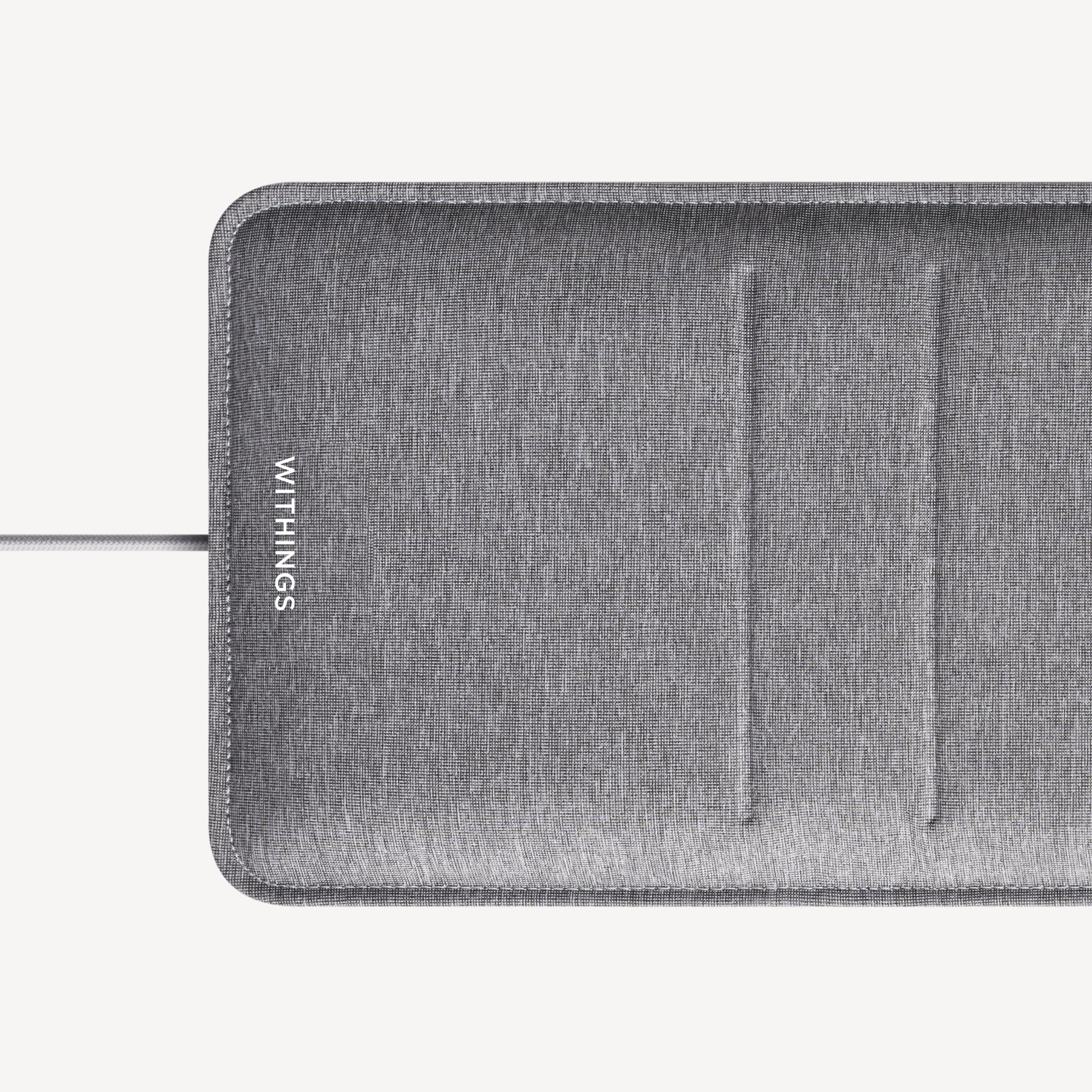
Temperature is the other big bedroom variable; see our bed cooling guide. If you track sleep, a Withings Sleep mat or the Eight Sleep Pod logs nights without anything on your wrist, though neither measures air quality. For the wider routine, see our sleepmaxxing guide.
Do air purifiers help with CO2?
No. Filters capture particles, and carbon filters adsorb some gases, but neither removes carbon dioxide. Ventilation does. The BP04 includes a CO₂ sensor that alerts you to ventilate, but it doesn't remove CO₂ itself. If your bedroom feels stuffy with the door closed, a CO2 monitor will tell you when to open a window.
Health evidence: what cleaner air can and can't do
In the trial below, portable HEPA filtration lowered indoor and personal fine-particle levels, but the health evidence for consumer purifiers is limited. In a double-blind crossover trial of 40 older adults in Detroit (Morishita et al., JAMA Internal Medicine, 2018), 3-day portable HEPA filtration cut personal PM2.5 from 15.5 to 7.4 µg/m³ with true HEPA, and systolic blood pressure fell by 3.2 mmHg with any filtration compared with sham. A follow-up analysis of the same study (Klaver et al., Toxics, 2023) found median indoor PM2.5 fell 58% with HEPA-type and 65% with true HEPA filters. The trial was small and short, so it doesn't show that a purifier lowers blood pressure over time.
The EPA calls filtration "an effective supplement to source control and ventilation", not a replacement. It also notes that air cleaners won't fix mold or moisture problems. The "99.97% at 0.3 microns" figure on every box is a filter-media spec, not how much of a room's air gets cleaned.
Ozone, ionizers and certifications
CARB defines filter-only ("Mechanical") purifiers as devices that "do not generate ozone or ions". The EPA warns that ionizers, electrostatic precipitators, plasma devices and uncoated UV lamps can, and it advises against ozone generators entirely. California's Air Resources Board (CARB) requires air cleaners sold there to meet an ozone emission limit of 0.050 ppm (50 ppb), and labels each certified model Mechanical or Electronic. CARB says it "does not evaluate the effectiveness of air cleaners at removing pollutants".
On the CARB list (checked Oct 4, 2026), Dyson's TP11 (PC1), TP12 (PC2), HP11 (HP1), HP12 (HP2), BP03, BP04, SP01-A (HushJet Compact) and TP07 appear as Mechanical. Dyson's US product data identifies the HP1 as HP11, the HP2 as HP12 and the HushJet Compact as SP01-A. Coway's AP-1512HH and Blueair's 211i Max appear as Electronic, and the Levoit Core 300, Core 300S, Core 400S and Vital 200S as Mechanical.
The other two labels worth knowing: AHAM Verifide confirms a CADR claim, and ENERGY STAR certifies efficiency and lists CADR in a public dataset.
Regulatory status: Consumer air purifiers like Dyson, Coway, Levoit, Blueair and Xiaomi aren't FDA-cleared medical devices. A few brands (e.g. Molekule's Air Pro RX, 510(k) K200500) hold FDA 510(k) clearance as Class II medical air purifiers (product code FRA); we found no such clearance for the models in this guide (openFDA, Oct 4, 2026).
Verdict: who should buy a Dyson, and who shouldn't
Buy a Dyson if you want one device that cools (and on HP models heats) as well as purifies, you value the app, sensors and design, and you'll pay for that. The PC1 at $399.99 on sale is the cheapest way into a Dyson fan purifier. The Big+Quiet BP03/BP04 is Dyson's strongest cleaner; its sibling, the BP06, tested close to 200 cfm.
Skip Dyson if clean air per dollar is the goal. A Levoit Core 300 ($84.97 on sale) or Vital 200S ($169.99) suits most bedrooms, and the Blueair 211i Max ($349.99) covers large rooms with a published 435 cfm smoke CADR.
FAQ
Is a Dyson a good air purifier?
It cleans air, but not efficiently for the price. Independent tests put the TP07 behind a Levoit Core 300 that costs about an eighth as much ($84.97 on sale vs $649.99, checked Oct 4, 2026). You pay for the fan or heater, design, sensors and app.
Which Dyson air purifier should I buy?
For a small bedroom, the HushJet Compact ($299.99 on sale) or PC1 ($399.99 on sale). For winter heat, the HP1 or HP2. For a large open-plan room, the Big+Quiet BP03 or BP04. The PC2 adds Dyson's NO₂ and formaldehyde claims to the PC1. Prices checked Oct 4, 2026.
How much do Dyson filters cost per year?
About $80 to $90 a year for the PC1 and HP2 filters (12-month interval). The Big+Quiet's K-Carbon filter costs $109.99 every 2 years and its HEPA $169.99 every 5 years.
Is Dyson or Shark better for air purifiers?
We found no independent test comparing current models, so we can't say. Both brands have models on CARB's certified list.
Is Dyson or Philips better for air purifiers?
Philips publishes CADR (149 cfm for the 1000i); Dyson doesn't. We can't compare value, because Philips' US page showed no price for the 1000i on Oct 4, 2026.
Do Dyson purifiers produce ozone?
The Dyson models we found on CARB's list, including the HushJet Compact (SP01-A), are certified as Mechanical, which CARB defines as devices that "only use physical filtration" and "do not generate ozone or ions".
Is a Dyson air purifier FDA-approved?
No. We found no FDA 510(k) clearance for any Dyson, Coway, Levoit, Blueair or Xiaomi purifier on openFDA (Oct 4, 2026).
How we researched this
We checked official product pages (dyson.com, cowaymega.com, levoit.com, blueair.com, mi.com), the EPA's air cleaner guide, CARB's certified list, the ENERGY STAR dataset, openFDA and published independent tests on Oct 4, 2026 (PT). We didn't run lab tests and received no products. Where only a brand's figure exists, we say so.
BiohackList has no affiliate relationship with any brand mentioned here. Read our disclosure and about BiohackList.
Disclaimer: This article is for information only and is not medical advice. Air purifiers aren't medical devices and aren't a treatment for asthma, allergies or any condition. If you have a respiratory condition, follow your clinician's advice. Prices and specs change; check the retailer before buying. BiohackList may earn commissions from qualifying purchases in the future.
Last checked: Oct 4, 2026 (PT).
Sources
- Dyson product pages, US (PC1, PC2, HP1, HP2, BP03, BP04, HushJet, TP07) and spare parts pages, checked Oct 4, 2026: https://www.dyson.com/air-treatment/air-purifiers
- PC1: https://www.dyson.com/air-treatment/air-purifiers/purifier-cool-pc1/black-nickel
- PC2: https://www.dyson.com/air-treatment/air-purifiers/purifier-cool-pc2/de-nox-white-gold
- HP1: https://www.dyson.com/air-treatment/air-purifiers/purifier-hot-cool-hp1/white-silver
- HP2: https://www.dyson.com/air-treatment/air-purifier-heaters/purifier-hot-cool-hp2/de-nox-white-gold
- BP03: https://www.dyson.com/air-treatment/air-purifiers/big-quiet-formaldehyde/nickel-prussian-blue-bp03
- BP04: https://www.dyson.com/air-treatment/air-purifiers/big-quiet-formaldehyde/prussian-blue-gold-bp04
- HushJet Compact: https://www.dyson.com/air-treatment/air-purifiers/hushjet/white-silver
- Dyson, "What is CADR": https://www.dyson.com/discover/innovation/behind-the-invention/what-is-cadr
- HouseFresh, Dyson Purifier Cool TP07 review (updated Dec 17, 2025): https://housefresh.com/dyson-purifier-cool-tp07-review/
- HouseFresh, Dyson BP06 review (updated Dec 17, 2025): https://housefresh.com/dyson-bp06-review/
- Smart Air, "Dyson Pure Cool Air Purifier Review: Is it Worth?": https://smartairfilters.com/en/blog/dyson-pure-cool-air-purifier-filter-review/
- CBC Marketplace (Feb 6, 2021): https://www.cbc.ca/lite/story/1.5900782
- EPA, Guide to Air Cleaners in the Home: https://www.epa.gov/indoor-air-quality-iaq/guide-air-cleaners-home
- CARB, List of CARB-certified air cleaning devices: https://ww2.arb.ca.gov/list-carb-certified-air-cleaning-devices
- ENERGY STAR Certified Room Air Cleaners V3.0 dataset: https://data.energystar.gov/resource/gaa3-swy6.json
- openFDA 510(k) API: https://api.fda.gov/device/510k.json
- Coway Airmega Mighty AP-1512HH: https://cowaymega.com/products/mighty-ap-1512hh
- Levoit Core 300, 300S, 400S, Vital 200S: https://levoit.com/products/core300-p-air-purifier
- Blueair Blue Pure 211i Max: https://www.blueair.com/products/blue-pure-211i-max
- Xiaomi US air purifiers: https://www.mi.com/us/product-list/environment-appliance/air-purifier/
- Morishita M, et al. JAMA Intern Med. 2018. doi:10.1001/jamainternmed.2018.3308. PMID 30208394.
- Klaver ZM, et al. Toxics. 2023;11(12):1019. doi:10.3390/toxics11121019. PMID 38133420.