Sleepmaxxing, Fact-Checked: Does Mouth Tape Work? Nasal Dilators, Sleep Headbands and What's Actually Worth Buying (2026)
· BiohackList Editorial
Disclaimer: This article is for information only and is not medical advice. Loud snoring, gasping or pauses in breathing at night, or long-lasting insomnia can be signs of a sleep disorder such as obstructive sleep apnea. See a clinician before taping your mouth or relying on any sleep gadget, and don't use mouth tape if you have a blocked nose, a cold or allergies, or have been drinking or taking sedatives. BiohackList may earn commissions from qualifying purchases in the future.
Most sleepmaxxing products have thin evidence. Mouth tape has the least support and the most risk. A 2025 systematic review found benefit in only 2 of 10 small studies, and warned of serious harm for people who tape without checking their nose and breathing first. In a 2026 meta-analysis, nasal dilators didn't beat controls on objective sleep measures. Elemind's headband has one small, company-run trial: people fell asleep about 10 minutes faster than with a sham. The strongest evidence is for the free basics, plus CBT-I if you have chronic insomnia.
Red flags: see a doctor before buying anything
- Loud or frequent snoring, especially with daytime sleepiness or fatigue
- Someone has seen you stop breathing, or you wake choking or gasping
- Morning headaches or unrefreshing sleep
- Trouble falling or staying asleep at least 3 nights a week for 3 months or more (how the AASM describes chronic insomnia)
These can be signs of obstructive sleep apnea or chronic insomnia, both of which are treatable. You can find an accredited sleep center through the AASM.
Verdict at a glance: skip mouth tape unless a clinician has cleared you. Nasal dilators are low-risk but haven't beaten controls on objective sleep measures. Elemind is a fair experiment for slow sleep onset. Muse's sleep claims rest on internal data. Trackers can help if they don't make you anxious. Full table below.
What is sleepmaxxing (and is it bad)?
Sleepmaxxing is a social-media trend: chasing more and better sleep through routines, products and tracking. Merriam-Webster lists it as slang for "a form of sleep optimization", including physical aids such as mouth tape and supplements such as melatonin.
Ahrefs puts average US searches for "sleepmaxxing" at about 3,700 a month, lifted by spikes of about 36,000 (January 2025) and 26,000 (April 2026); most months run 1,000 to 3,000 (3,157 in September 2026).
In the American Academy of Sleep Medicine's 2025 survey of 2,007 US adults, 48% said they had used a sleep tracker, up from 35% in 2023. AASM says 55% of adults act on what a tracker tells them, without saying whether that share is of all respondents or tracker users.
Not by itself. The basics behind the trend are sound. Where it goes wrong is money spent on unproven gadgets, tape over a breathing problem that needs a diagnosis, and anxiety about sleep data. In the same survey, 76% said they had lost sleep worrying about sleep problems, sometimes called "orthosomnia".
The verdict table
Grades. A: guideline-level evidence. B: reasonable evidence with clear limits. C: small or company-run trials with some positive results. D: little supportive evidence, or trials showing no effect.
| Hack / product | What it claims | Best evidence (study, size) | Our grade | Main risk | Price (official, Oct 4, 2026) | FDA status (exact) | Verdict |
|---|---|---|---|---|---|---|---|
| Mouth tape (SomniFix, Hostage Tape) | Nose breathing, less snoring, better sleep | Rhee 2025 systematic review: 10 studies, 213 patients; 2 showed improvement | D | Suffocation risk with a blocked nose; can hide sleep apnea | SomniFix $25.99 for 30 strips; Hostage Tape $24.95 for a 30-day supply | No FDA clearance found | Skip, unless a clinician has ruled out nasal blockage and apnea |
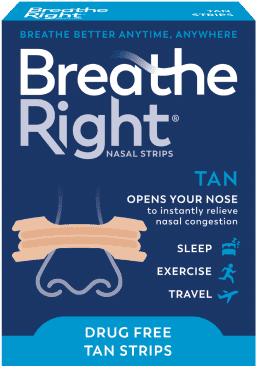
| External nasal strips (Breathe Right) | Open the nose, easier breathing | Alotaibi 2026 meta-analysis: 17 studies, 496 people, no difference vs control on objective measures; two RCTs in congested sleepers, no difference vs placebo strip | D (no better than a placebo strip, even in congested sleepers) | Low; can quiet snoring without treating its cause | Varies by retailer; no list price on Breathe Right's site | Class I nasal dilator, exempt from 510(k) review; Breathe Right was cleared through 510(k) in the 1990s (e.g., K953772) | Low risk, but any comfort benefit may be placebo |
| Magnetic nasal dilator (Intake) | More airflow, better sleep and training | Same meta-analysis; no Intake-specific trial found | D | Low; same masking problem as strips | Starter Kit $49.99 (4 bands, 15 tab pairs) | Class I nasal dilator, exempt from 510(k) review; "FDA registered" means registration and listing, not clearance | Low risk; no Intake-specific evidence |
| Elemind headband | Helps you fall asleep faster with sound timed to brainwaves | Bressler 2024 crossover RCT vs sham: 21 people analyzed, about 10.5 minutes faster sleep onset | C | Mild skin irritation in 3 trial participants; a partner may hear it | $399; membership $83.99 a year or $12.99 a month after a 30-day trial | Marketed as a general wellness product; Elemind says it is not a medical device | A fair experiment for slow sleep onset, within the return window |
| Muse S Athena | Faster sleep onset, more deep sleep, meditation feedback | Company "internal data" only for sleep claims | D for sleep improvement | Low | $474.99 | No FDA clearance found (no 510(k)) | Buy it for meditation and tracking, not as a sleep aid |
| Sleep trackers (Oura Ring 4, WHOOP 5.0, Withings Sleep) | Measure sleep and stages | Miller 2022 lab study: 53 adults, six devices; sleep vs wake agreement 86 to 89%, stages 50 to 65% | B for sleep vs wake; C for stages | Sleep anxiety | See listings | Sold as wellness devices for sleep (WHOOP's separate ECG feature is FDA-cleared, K243236) | Useful for trends; check data in the morning only |
| CBT-I (for chronic insomnia) | Fixes the habits and thoughts that keep you awake | AASM 2021 and ACP 2016 guidelines: strong recommendation | A | Low | Varies (therapist, insurance or program) | Not a product | First-line treatment for chronic insomnia |
| Magnesium, cooling, vagus nerve stimulation | Various | Not graded here | Not graded | See linked guides | See linked guides | See linked guides | See "Other sleepmaxxing hacks" |
Does mouth taping work? (and is it safe?)
Probably not for most people, and it can be unsafe. The strongest review found little evidence of benefit and a real risk of harm for anyone who tapes without first checking for a blocked nose or sleep apnea.
What the research shows
Rhee and colleagues' 2025 systematic review in PLOS One pooled 10 studies with 213 patients. Only 2 showed a significant improvement in the apnea-hypopnea index (AHI) or oxygen levels. The rest found no difference. Many studies excluded people with nasal obstruction, the very group most at risk. The authors concluded there is a "potentially serious risk of harm for individuals indiscriminately practicing this trend."
A 2025 scoping review in the American Journal of Otolaryngology looked at mouth-taping claims on social media and found only 9 qualifying studies out of 177 screened. Two found some improvement in obstructive sleep apnea: one with tape alone, one with tape plus a mandibular advancement device. The authors found "little consensus" and noted that few of the claims made on TikTok had been studied at all.
Cleveland Clinic agrees there isn't enough evidence that mouth taping stops snoring.
The catch-22
The people most tempted to tape tend to be the ones who most need a check-up. In PolitiFact's Sep 29, 2026 fact-check, Dr. Aatif Husain, a Duke neurology professor who leads its epilepsy, sleep and clinical neurophysiology division, said: "Chronic mouth breathing is usually a sign of something else, such as nasal obstruction, allergies, deviated septum or sleep apnea. It is better to find and treat that cause than to 'tape over it.'"
Dr. Brian Rotenberg of Western University told PolitiFact there is "very little evidence" for mouth taping and "some clear evidence of risk." He's also the senior author of the PLOS One review, so read his comments as the review's authors speaking, not separate confirmation.
Who should never tape
Don't tape if any of these apply (from Cleveland Clinic, the PLOS One review and our disclaimer):
- A blocked or congested nose, a cold, sinus infection or chronic allergies
- A deviated septum, enlarged tonsils or other known nasal obstruction
- Heart problems (Cleveland Clinic lists these)
- Loud snoring, witnessed pauses in breathing or other signs of sleep apnea that haven't been checked
- You've been drinking or taking sedatives
- You feel sick or might vomit in the night (the review flags aspiration risk)
- Children, unless a clinician advises it
If you still want to try it
See a clinician first, ideally one who can check your nose and screen for sleep apnea. As Rotenberg told PolitiFact, "In the absence of a known diagnosis for why one's nose is blocked, it does not make sense to mouth tape." If you use CPAP, ask your sleep physician before adding tape or a chin strap.
Mouth tape products and prices
SomniFix Mouth Strips were $25.99 for 30 strips, with a 30-night money-back guarantee, and Hostage Tape was $24.95 for a 30-day supply. Both prices were checked Oct 4, 2026. We found no FDA clearance for any mouth tape. SomniFix International does appear in FDA's registration database, with a product listed under the nasal-dilator code. That's a registration and listing, not a clearance.
Nasal dilators: strips vs magnetic dilators
According to the most recent meta-analysis, nasal dilators don't improve objective sleep measures on their own. The meta-analysis authors say they may help as an add-on for mild symptoms or congestion, but Breathe Right's own trials in congested sleepers found no edge over a placebo strip. They aren't a fix for snoring or sleep apnea.
Intake uses an external band held on with magnets and adhesive tabs.
A 2026 meta-analysis in Cureus by Alotaibi and colleagues pooled 17 studies with 496 participants, covering internal and external dilators. Against control, dilators made no significant difference to AHI, snoring index, total sleep time, sleep architecture, oxygen saturation or nasal airway resistance. The authors said dilators "cannot be recommended as monotherapy" and "may be helpful as adjunctive therapy in specific populations with mild symptoms or nasal congestion."
Breathe Right's own trials. Two double-blind trials of Breathe Right strips in adults with chronic nighttime congestion (140 and 130 people, 14 nights) found no significant difference from a placebo strip on sleep problems or tiredness. Both groups improved, "possibly due to a strong placebo effect," the authors wrote. GSK Consumer Healthcare funded the trials.
Intake. Intake calls its tabs "FDA registered", and openFDA shows Intake Breathing Technology LLC registered with a nasal dilator listed. We found no Intake-specific clinical trial. Its Starter Kit was $49.99 for 4 bands and 15 pairs of tabs, checked Oct 4, 2026.
What "FDA registered" means. Nasal dilators are Class I medical devices that are exempt from FDA premarket (510(k)) review. "FDA registered" means the company registered its facility and listed the product, not that FDA evaluated it. Breathe Right was cleared through 510(k) in the 1990s (for example, K953772), before dilators became exempt.
They're low-risk if you want to try one for a stuffy nose, but expect any benefit to be modest and possibly placebo. Cleveland Clinic lists nasal strips among safer options than mouth tape. Loud snoring still needs a sleep apnea check.
Sleep headbands: can a headband put you to sleep?
One headband has a peer-reviewed trial, and the effect was modest: people fell asleep about 10 minutes faster than with a sham. Muse's sleep claims come from internal data. We found no FDA clearance for either headband.
Elemind
Elemind reads brainwaves with five EEG sensors and plays sound through a bone-conduction speaker, timed to dampen the alpha waves linked to being awake. It costs $399. After a 30-day trial of full features, membership is $83.99 a year or $12.99 a month. Returning it within the 30-day money-back window costs $40 in shipping and restocking fees.
The evidence is a single randomized crossover trial by Bressler and colleagues in Scientific Reports (2024). Of 100 people enrolled, 21 were analyzed, mostly because of dropouts and EEG data quality. Against silent sham nights, time to fall asleep dropped by 10.5 ± 15.9 minutes on average, and 76.2% of participants did better than sham. All four authors are Elemind employees, and the company sponsored the study. Elemind's marketing goes further ("on average 48% faster", "better than leading sleep aids"); we didn't find those claims in the paper.
Elemind calls the headband "a general wellness product" and says it "is not a medical device". We found no FDA clearance or registration. Tom's Guide's sleep editor found it worked for her, but her husband could hear it, and she found it uncomfortable for side sleeping.
For our full take, read the Elemind headband review.
Muse S Athena
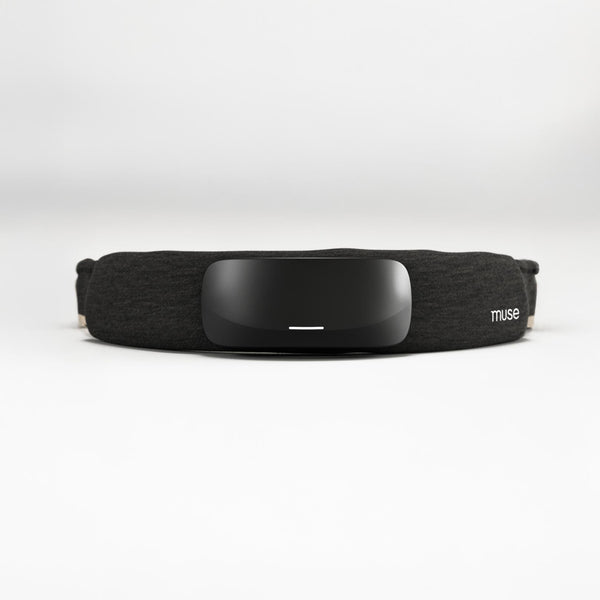
Muse S Athena is a soft EEG headband from InteraXon that also measures heart rate and what Muse calls brain blood oxygenation. It was $474.99 on Muse's US store, labeled a sale price. Sleep tracking, Sleep Assist and Deep Sleep Boost come free with the device. Premium, which adds extras such as Smart Wakeup, has two prices on Muse's own site: its Premium page lists $12.99 a month or $49.99 a year, while its Premium store listing shows $109.99 a year (both checked Oct 4, 2026). Confirm the price at checkout.
Muse advertises "55% faster sleep onset" and "42% more slow-wave activity", and labels both "Internal data". We found no published trial of those features. We found no FDA clearance for Muse S Athena (no 510(k) on file). Buy it for meditation feedback and sleep tracking, not as a proven sleep aid.
Who should skip a headband
- Severe hearing impairment: Elemind says it won't work.
- Side sleepers: one reviewer found Elemind uncomfortable, though Elemind says it suits every position.
- Insomnia most nights for months: see a clinician about CBT-I first.
Sleep trackers: helpful or making it worse?
Trackers are reasonably good at telling sleep from wake and much weaker on sleep stages. They can help you spot trends. They can also feed sleep anxiety. The AASM suggests checking your data only in the morning.
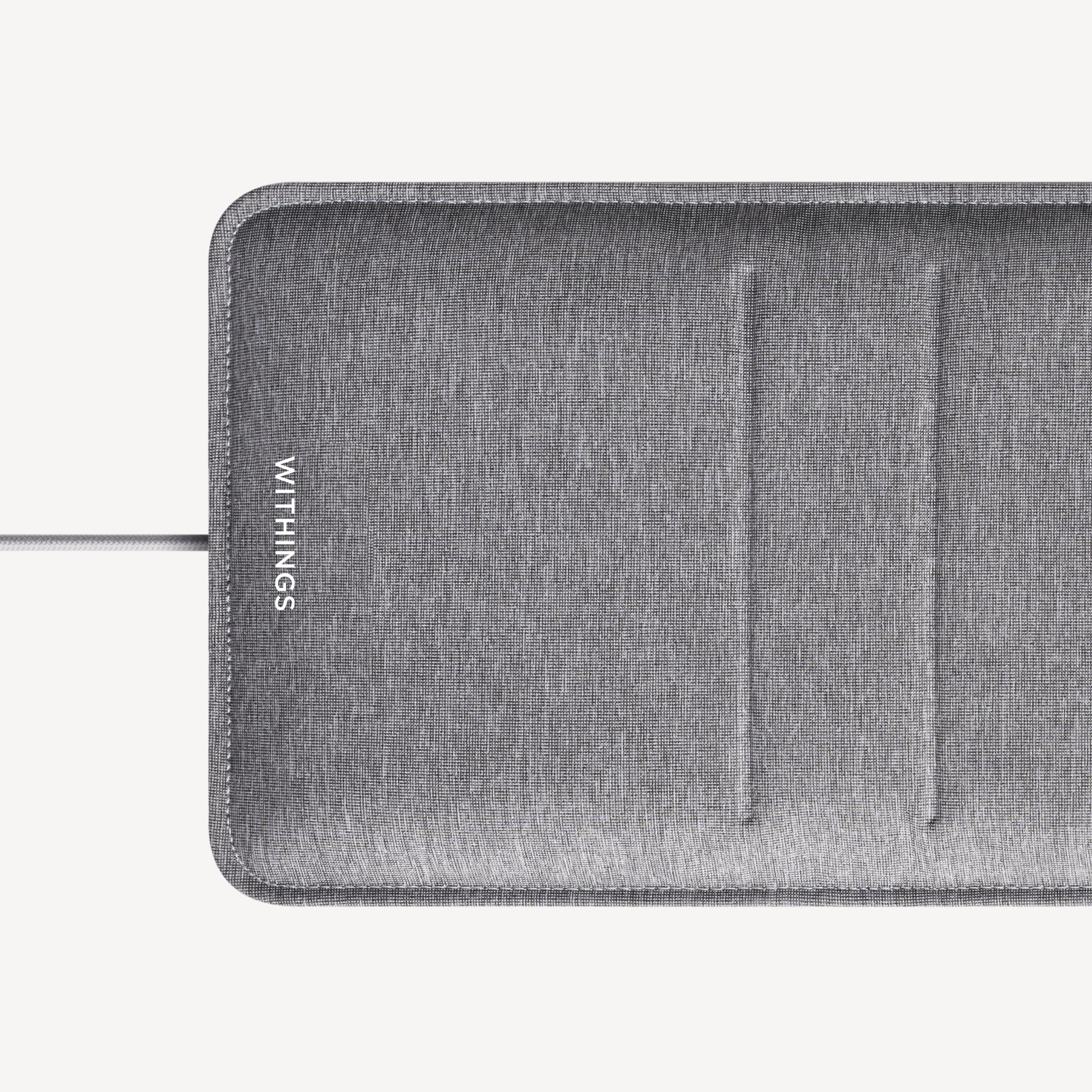
In a 2022 lab study of six wearables in 53 adults, including an earlier WHOOP model, agreement with lab sleep tests was 86 to 89% for sleep vs wake but only 50 to 65% for sleep stages. The authors' lab gets support from WHOOP. Read stage breakdowns loosely.
If you want one, our listings cover Oura Ring 4, Oura Ring 5, WHOOP 5.0 and the under-mattress Withings Sleep. For screenless bands without a subscription, see our Garmin Cirqa vs WHOOP comparison. For the ring-versus-band choice, see WHOOP vs Oura.
Other sleepmaxxing hacks, one line each
- Magnesium: popular, with mixed evidence. See which magnesium is best for sleep.
- Red light at night: we cover red light therapy at home separately and make no sleep claims for it.
- Vagus nerve stimulation: our guide to vagus nerve stimulators for sleep and stress compares the consumer devices.
- Stress and "cortisol" talk: if you're curious about testing cortisol at home, read what those tests can and can't tell you first.
- Cooling: if you sleep hot, the Eight Sleep Pod Cover is our listed temperature-control option. A cool room is the free version.
A sensible sleepmaxxing routine (free first)
Start with common sleep-hygiene habits that cost nothing:
- Keep a consistent wake time, including weekends.
- Get daylight in the morning and keep evenings dimmer.
- Set a caffeine cutoff. In a small lab study, 400 mg of caffeine taken 6 hours before bed still cut sleep by more than an hour. The study had only 12 people.
- Leave a gap between alcohol and bedtime. The AASM notes that drinking close to bedtime can disrupt sleep.
- Make the room cool, dark and quiet.
- Wind down with something calm that isn't work.
- Check tracker data in the morning only, if you use one, as the AASM advises.
What is the 10-3-2-1-0 rule? It's a popular rule of thumb: no caffeine 10 hours before bed, no food or alcohol 3 hours before, no work 2 hours before, no screens 1 hour before, and zero snooze presses. We couldn't trace it to a guideline, so use it as a memory aid.
When to see a doctor instead
See a clinician if you have any of the red flags at the top of this page. A doctor may order a sleep study at home or in a lab to check for sleep apnea.
For chronic insomnia, the first-line treatment is cognitive behavioral therapy for insomnia (CBT-I). The AASM's 2021 guideline gives multicomponent CBT-I a strong recommendation, and the American College of Physicians' 2016 guideline, still its most recent on insomnia as of Oct 4, 2026, recommends it as the initial treatment for adults. It's available in person, by video and online, per the AASM's Sleep Education site. Don't change any sleep medication without talking to your doctor.
FAQ
What exactly is sleepmaxxing?
It's a social-media trend: chasing more and better sleep with routines, products and tracking. Merriam-Webster lists it as slang for sleep optimization.
Is sleepmaxxing bad?
Not inherently. The basic habits are sound. The risks are unproven gadgets, taping over a breathing problem, and sleep anxiety. In an AASM survey, 76% of US adults had lost sleep worrying about sleep problems.
Does mouth taping work?
The evidence is weak. A 2025 systematic review of 10 studies with 213 patients found improvement in only 2, both small, and warned of serious risk for people who tape without first ruling out nasal obstruction.
Is mouth taping safe?
It can be unsafe. Taping is risky if your nose is blocked, and it can hide signs of sleep apnea. Talk to a clinician first.
Who should avoid mouth taping?
Anyone with a blocked nose, a cold, allergies, a deviated septum, enlarged tonsils, heart problems or possible sleep apnea; anyone who has been drinking or taking sedatives; and children unless a clinician advises it.
Is mouth tape FDA-approved?
No. We found no FDA clearance for any mouth tape. A registration in FDA's database only means a company registered a facility and listed a product.
Breathe Right vs Intake: which nasal dilator is better?
Neither has strong evidence for better sleep. As a group, dilators didn't improve objective sleep measures in a 2026 meta-analysis. Intake's bands are reusable; Breathe Right strips are single-use.
Is Elemind worth $399?
Possibly, if slow sleep onset is your main problem and you use the 30-day return window ($40 in fees). Its one trial, run by Elemind staff, found about 10.5 minutes faster sleep onset vs sham in 21 people.
How we researched this
We used official US product pages and FAQs from SomniFix, Hostage Tape, Intake, Breathe Right, Elemind and Muse, checked Oct 4, 2026 (PT). We queried FDA's openFDA classification, 510(k) and registration databases the same day and checked the nasal-dilator rule (21 CFR 874.3900) on eCFR. Study figures come from the papers or their abstracts. Expert quotes come from PolitiFact and Cleveland Clinic, credited above. We haven't tested these products, and there are no affiliate links on this page. See our affiliate disclosure and how listings are added.
Last checked: Oct 4, 2026.
Disclaimer: This article is for information only and is not medical advice. Loud snoring, gasping or pauses in breathing at night, or long-lasting insomnia can be signs of a sleep disorder such as obstructive sleep apnea. See a clinician before taping your mouth or relying on any sleep gadget, and don't use mouth tape if you have a blocked nose, a cold or allergies, or have been drinking or taking sedatives. BiohackList may earn commissions from qualifying purchases in the future.
Sources
- Merriam-Webster, 'sleepmaxxing' (slang)
- American Academy of Sleep Medicine, 2025 Sleep Prioritization Survey release (2,007 US adults, Jun 5 to 13, 2025)
- Rhee J, et al. Mouth taping systematic review. PLOS One 2025. doi:10.1371/journal.pone.0323643. PMID 40397877
- Fangmeyer SK, Badger CD, Thakkar PG. Nocturnal mouth-taping and social media: A scoping review. Am J Otolaryngol 2025. doi:10.1016/j.amjoto.2024.104545. PMID 39662104
- PolitiFact, Madison Czopek, 'Mouth taping for better sleep? Why this trendy hack might hide a bigger problem' (Sep 29, 2026)
- Cleveland Clinic, 'Is Mouth Tape Safe To Use While Sleeping?' (Jul 25, 2025)
- Alotaibi S, et al. Nasal dilators in sleep-disordered breathing: systematic review and meta-analysis. Cureus 2026. doi:10.7759/cureus.100663. PMID 41487318
- Noss MJ, Ciesla R, Shanga GM. Sleep quality and congestion with Breathe Right nasal strips: two randomized controlled trials. Adv Ther 2019. PMID 31209698
- Bressler S, et al. A randomized controlled trial of alpha phase-locked auditory stimulation to treat symptoms of sleep onset insomnia. Sci Rep 2024;14:13039. doi:10.1038/s41598-024-63385-1. PMID 38844793
- Miller DJ, Sargent C, Roach GD. A validation of six wearable devices for estimating sleep, heart rate and heart rate variability in healthy adults. Sensors 2022;22:6317
- Drake C, et al. Caffeine effects on sleep taken 0, 3, or 6 hours before going to bed. J Clin Sleep Med 2013. PMID 24235903
- Edinger JD, et al. Behavioral and psychological treatments for chronic insomnia disorder in adults: an AASM clinical practice guideline. J Clin Sleep Med 2021. PMID 33164742
- Qaseem A, et al. Management of Chronic Insomnia Disorder in Adults: ACP guideline. Ann Intern Med 2016 (ACP's most recent insomnia guideline; no newer ACP version found 2026-10-04). PMID 27136449
- AASM Sleep Education, Insomnia (chronic insomnia definition)
- AASM Sleep Education, Obstructive Sleep Apnea (symptoms)
- eCFR, 21 CFR 874.3900 Nasal dilator (Class I, exempt from premarket notification)
- FDA, Device Registration and Listing
- FDA 510(k) K953772, Breathe Right nasal strip (CNS, Inc.)
- SomniFix Mouth Strips product page (30 strips $25.99) (checked 2026-10-04)
- Hostage Tape product page (30-day supply $24.95) (checked 2026-10-04)
- Intake Breathing starter kits ('FDA registered'; Starter Kit $49.99 with 4 bands and 15 tab pairs) (checked 2026-10-04)
- Elemind product page and US FAQ ($399; membership after 30 days: FAQ says 'Annual: $6.99/month ($83.99/year). Monthly: $12.99/month.'; 'not a medical device... general wellness product') (checked 2026-10-04)
- Muse S Athena product page ($474.99; sleep figures labeled 'Internal data') (checked 2026-10-04)
- Muse Premium page ($12.99/mo or $49.99/yr; Sleep Assist and Deep Sleep Boost free with device) (checked 2026-10-04)
- Muse Premium App Subscription store listing ($109.99, 1 year; conflicts with the Premium page) (checked 2026-10-04)
- FDA 510(k) K243236, WHOOP ECG Feature (cleared 2025-04-04)
- Tom's Guide, Nicola Appleton, Elemind hands-on (updated Mar 27, 2026)