Acupressure Mats (2026): Do They Work, and How to Choose One
· BiohackList Editorial
Disclaimer: This article is for information only and is not medical advice. Acupressure mats are wellness products, not treatments for insomnia, back pain or any condition. Don't use one on broken or irritated skin. If you're pregnant, have a bleeding disorder or take blood thinners, have reduced sensation (e.g. diabetic neuropathy), or have back pain that's severe, new after an injury, or comes with numbness or weakness, talk to a clinician first. BiohackList may earn commissions from qualifying purchases in the future.
Verdict in 30 seconds: Good for: a cheap, drug-free wind-down ritual. Evidence: in the best-controlled trial, no better than relaxing without spikes for sleep and stress. Three small pilot trials in people with chronic neck or back pain found some pain relief against no treatment, with no sham mat. Buy: a $30 mat to test the idea. Spend more only for things you can check: intensity levels, materials, return window and warranty.
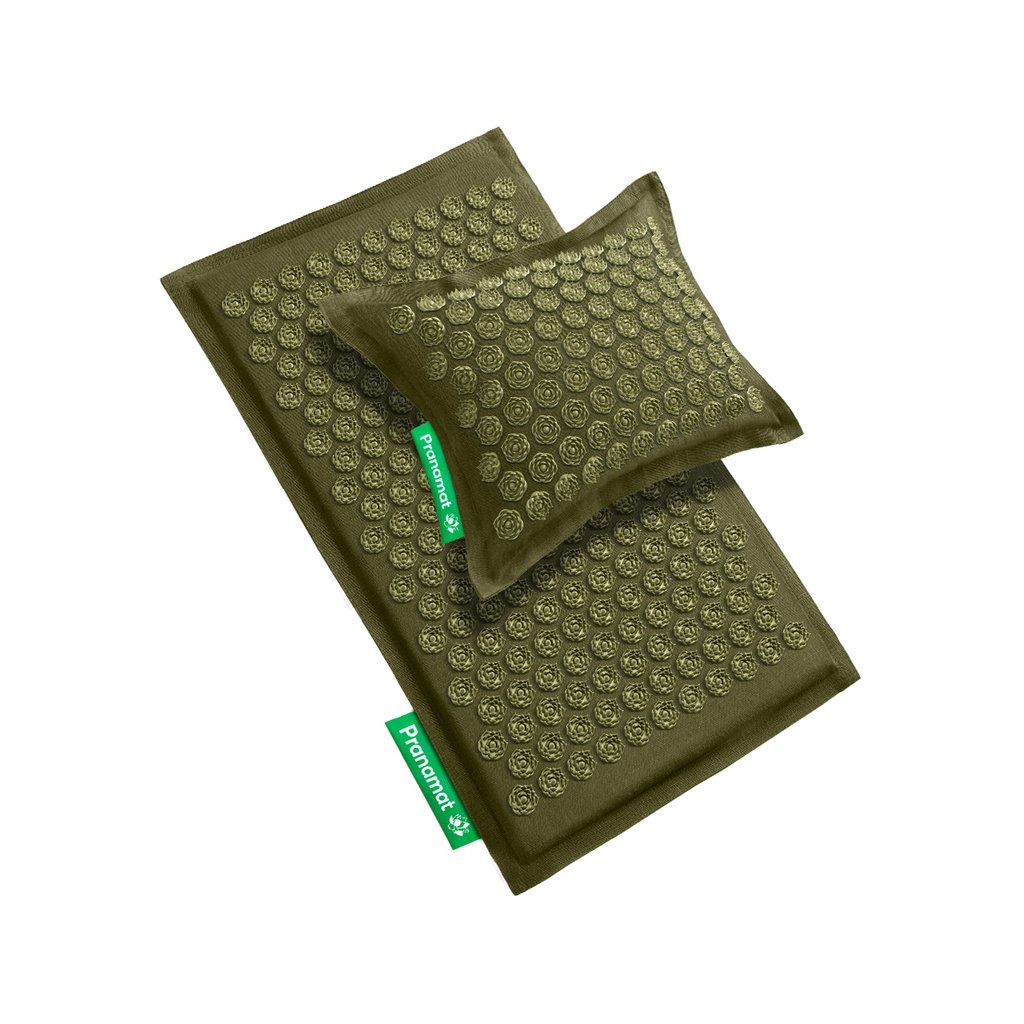
An acupressure mat (also sold as a bed of nails mat, spike mat or nail mat) is a foam or fiber pad covered in plastic discs with blunt spikes. You lie on it for a few minutes to half an hour. Prices run from $29.98 to $470 (checked Oct 4, 2026). Three small controlled studies exist. The best-designed found that a mat did no better than plain relaxation for stress or sleep.
We didn't test mats in a lab. This guide uses official product pages, the published studies and openFDA, checked on Oct 4, 2026 (PT), plus one short section from Frederik, who runs BiohackList, about how he uses his.
What an acupressure (bed-of-nails) mat is
It's a mat studded with hundreds of plastic spike discs, not nails. ProsourceFit's mat has 6,210 points. Shakti's mats range from just over 8,000 spikes (Level 1) to 4,000 (Level 3). Fewer spikes means more pressure on each one, so Level 3 feels sharper. Most of the sets we compared include a neck pillow.
"Acupressure" borrows its name from traditional Chinese medicine, which presses points believed to sit on energy channels. You don't have to accept that theory to use a mat, and the studies below don't test it. What a mat certainly does is press on a large area of skin. In one trial, first-time users rated the discomfort as mild: about 15 out of 100 at the first session and about 11 in the second week.
Acupressure mat benefits: what the studies show
The evidence is thin. One well-controlled trial found no advantage over relaxing without a mat. Three small pilot trials in people with chronic neck or back pain found some pain relief compared with no treatment, but none used a sham mat.
Stress and sleep
Kisker and Schöne, 2024 (Applied Psychology: Health and Well-Being) is the most useful study, because it had an active control group. Healthy young students who had never used a mat practiced relaxation for three weeks, either on a mat or without any tools. In both groups, perceived stress fell and sleep quality improved. Blood pressure, heart rate, pain threshold and pain tolerance didn't change significantly. The authors found "no significant differences" between the groups. (We could access only the study's abstract.) Speaking to the Guardian in January 2026, the senior researcher described the stress reduction as "about 7%" and said "it's just due to lying down and relaxing."
Neck and back pain
Kjellgren et al., 2011 (Alternative Medicine Studies) was a randomized controlled pilot in 36 adults with stress-related muscle tension pain in the back or neck. Of these, 21 rested on a spike mat for 15 minutes on at least five days a week for three weeks, and 15 controls had no intervention. The mat group's worst-pain ratings fell from 68.14 to 53.81 on a 100-point scale, against 66.93 to 64.80 in controls (P = 0.042). Everyday ("normal") pain didn't change, and the study found no effect on anxiety, depression, optimism, stress, energy or sleep quality. There was no sham mat, and the authors write that placebo effects "should not be underestimated" and that more research is needed.
Hohmann et al., 2012 (Evidence-Based Complementary and Alternative Medicine) ran two pilot trials: one in 40 people with chronic neck pain, one in 42 with chronic low-back pain. Participants used a needle stimulation pad for 14 days, compared with a waiting list. Pain ratings fell more in the pad groups, by 1.6 points (neck, P = .021) and 2.3 points (low back, P < .001) on a 0 to 10 scale. Neck disability scores improved, but low-back disability scores didn't. There was no sham mat, so expectation effects can't be ruled out. The Carstens Foundation funded the study and also appears among the authors' affiliations.
What's unproven
No controlled study supports the common marketing claims: endorphin or "happiness hormone" release, better circulation as a health benefit, deeper sleep, reduced cellulite, or benefits from sleeping on a mat overnight. Product pages make several of these claims. We don't repeat them as fact.
Does an acupressure mat help you sleep?
There's no evidence that it improves sleep more than any other relaxation routine. In both trials that measured sleep, the mat made no difference compared with the control. Where a mat may help is as a fixed wind-down habit: a set time, lights low, 15 to 20 minutes lying still. That's the part the research points to, and you can do it with or without spikes.
If you're building an evening routine, the free basics come first: a cool, dark room and a regular schedule. See our sleepmaxxing guide and our magnesium explainer. Other wind-down tools work differently: nervous-system wearables like Pulsetto and Apollo (see the Pulsetto and Apollo Neuro listings), or an EEG headband such as the Elemind. See the Elemind headband review.
How I use mine (Frederik)
Frederik, who runs BiohackList, uses a mat himself. This is his routine as he described it to us: one person's uncontrolled experience, not evidence.
I use a Shakti mat in two situations. The first is to relax before bed. The second, and the one I value most, is when I wake in the middle of the night and can't get back to sleep. About 20 minutes on the mat and I'm dozing off. I also have a travel version. It's "a life changer."
BiohackList has no affiliate relationship with any brand mentioned here. Read our disclosure and about.
That's one person's experience. The studies didn't test middle-of-the-night use: Kjellgren 2011 found no effect on sleep quality, and Kisker 2024 found no difference from relaxation alone.
How to choose an acupressure mat
Nothing head-to-head shows that a $470 mat works better than a $30 one, so choose on things you can check:
- Intensity. More spikes per disc spread the pressure and feel gentler. Some brands sell levels. The budget mats we checked come in one.
- Base and filler. Foam is light and cheap. Coconut fiber is firmer. Pranamat says its coconut-fiber filler "contains traces of naturally-occurring latex", and Shakti's Premium mat is filled with organic latex foam, so check the materials list if you're sensitive to latex.
- Fabric and cleaning. Covers on the mats we checked are cotton or linen where the brand states it. Check the care instructions before washing.
- Size. Standard mats cover your back. Full-body sets add length or a second mat.
- Travel size. Shakti sells a foam-free To-Go mat for $79: 20.2 by 14 inches flat, 0.7 lb, Level 2 spikes, rolling into its own pouch (checked Oct 4, 2026). Shakti says it's about 40% of the size of a full mat.
- Returns and warranty. Return windows run 30 to 60 days where stated, and warranties up to 5 years. We didn't confirm warranties for the budget mats.
The options compared
Prices checked on official sites on Oct 4, 2026 (PT). We didn't test these mats.
| Mat | Materials | Intensity | Price | Returns | Warranty |
|---|---|---|---|---|---|
| Gaiam Acupressure Mat & Pillow | Not stated; mat 25 x 15.75 in | One | $29.98 | Retailer policy | Not checked |
| ProsourceFit Acupressure Mat and Pillow Set | Cotton and plant-based foam; 6,210 points | One | $29.99 (ProsourceFit's separate Full Body set: $49.99) | Not checked | Not checked |
| WTHN Acupressure Mat Set | Coconut fibre and linen; mat 28.5 x 17 x 1 in, memory-foam pillow, carry case | One | $88 | Not checked | Not checked |
| Shakti Classic | Polyurethane foam; organic cotton outer | 3 levels | $99 list; 20% off until Oct 6, 2026 per site banner | 60 days | 5 years |
| Shakti Premium | Organic latex foam ("Blissfoam"); organic cotton; 29.13 x 15.75 in | 4 levels | $119 list; same 20% promo | 60 days | 5 years |
| Shakti To-Go (travel) | Foam-free, water-resistant organic cotton base; 20.2 x 14 in, 0.7 lb | Level 2 | $79 | 60 days | 5 years (per product page) |
| Pranamat Classic Mat + Pillow | Linen and cotton; coconut fibre with traces of latex; buckwheat pillow | One | $340 (Full Body Original set $470; prices include US import duties) | 30-day trial | 5 years |
| Nayoya Mat & Neck Pillow | Not checked | Not checked | Unavailable on Amazon on Oct 4, 2026 | n/a | n/a |
⚠ Recheck at publish: Shakti's 20% promo ends Oct 6, 2026, and WTHN's product page still showed a pre-order note about September shipping on Oct 4, 2026. Confirm both, and all prices, before publishing.
Lyapko applicators, which use metal needles on a rubber base, are a different design. They have no more evidence behind them than plastic-disc mats, and we couldn't confirm a US price from an official store.
Budget mats (Gaiam, ProsourceFit)
At about $30, the Gaiam and ProsourceFit sets are the cheapest way to see if you like the sensation. The trade-off is one intensity, and less information about materials and warranty.
Mid-price (WTHN)
WTHN's $88 set adds a coconut-fiber mat, memory-foam pillow and carry case. When we checked, its product page still carried a pre-order note about September shipping, so confirm stock before ordering.
Shakti vs Pranamat
They're built differently, not proven differently. Shakti uses spike discs on foam or latex foam and sells three (Classic) or four (Premium) intensity levels. It offers a 60-day return window and a 5-year warranty, at $99 to $119 list. Pranamat uses flower-shaped HIPS plastic "lotus" massagers on a coconut-fiber base, is made in the EU, costs $340 to $470 including US import duties, and offers a 30-day trial and a 5-year warranty. Pranamat's site claims sleep and cellulite benefits. No controlled study supports those claims for any mat.
How to use one safely
Start short and build up. Brands suggest longer sessions than an acupuncturist interviewed by the Guardian does:
- Start with a few minutes, with a thin shirt on if the spikes feel too sharp. Gaiam suggests starting at 10 minutes a day and working up to 30.
- Typical sessions run about 20 minutes; Shakti calls 20 minutes "the average". An acupuncturist interviewed by the Guardian advises no more than five minutes at a time.
- Lie down and get up slowly. Sit on the mat first, then lower your back onto it.
- Expect redness and dimpled skin afterwards. Stop if your skin breaks or stays irritated.
- Don't sleep on it all night. There's no research on overnight use.
Who shouldn't use an acupressure mat
Shakti lists these contraindications: anticoagulant use or coagulation problems, epilepsy, damaged skin, neuropathy with loss of sensation, cardiovascular conditions, thrombophlebitis and fever. It says mats aren't for use in pregnancy or by children. Pranamat says children need adult supervision at all times because of the sharp petals.
Back pain that needs a clinician, not a mat. The NHS says to call emergency services if back pain comes with pain, tingling, weakness or numbness in both legs, loss of feeling around the genitals or anus, changes in bladder or bowel control, chest pain, or if it started after a serious accident. It recommends urgent advice if you feel feverish or unwell, or if the pain is severe, sudden or getting worse quickly.
Regulatory status: Acupressure mats aren't FDA-cleared or FDA-approved; they're sold as wellness/massage products. FDA has cleared some acupressure wristbands for nausea (product code MVV), but we found no 510(k) for acupressure mats from Shakti or other brands (openFDA, checked Oct 4, 2026).
FAQ
Do acupressure mats really work?
For relaxation, about as well as relaxing without one in the best trial. For chronic neck and back pain, three small pilot trials found less pain than with no treatment (in one, only worst pain, not everyday pain), with no sham comparison. There's no good evidence for other claims.
How long should you lie on an acupressure mat?
Brands suggest about 20 minutes (Shakti) or 10 to 30 (Gaiam). An acupuncturist quoted by the Guardian suggests five minutes at most. Start with a few minutes and build up.
What are the downsides of acupressure mats?
Redness, dimpled skin and some discomfort. They're not for broken skin, and people who are pregnant, take blood thinners, have bleeding disorders or reduced sensation should check with a clinician first. Some mats contain latex (coconut-fiber fillers, latex foam), so check the materials.
Is it okay to fall asleep on an acupressure mat?
A user cited by the Guardian says they often fall asleep on their mat, but no study has looked at overnight use. Don't plan to sleep on it all night.
Are cheap mats as good as expensive ones?
No study has compared them. They work on the same principle. Differences are in spike density, base material, fabric, returns and warranty.
Is a bed of nails the same as an acupressure mat?
For consumer products, yes. Both names describe a mat of plastic spike discs, not metal nails.
Are acupressure mats FDA-approved?
No. They're sold as wellness products, and we found no FDA 510(k) clearance for any acupressure mat (openFDA, Oct 4, 2026).
How we researched this
We checked official product pages, the three published controlled studies (full text for Kjellgren 2011 and Hohmann 2012; abstract only for Kisker 2024), the Guardian's January 2026 report, NHS guidance and openFDA on Oct 4, 2026 (PT). We didn't run tests or receive products. Frederik's section is based on what he told us, labeled as such.
BiohackList has no affiliate relationship with any brand mentioned here. Read our disclosure and about.
Disclaimer: This article is for information only and is not medical advice. Acupressure mats are wellness products, not treatments for insomnia, back pain or any condition. Don't use one on broken or irritated skin. If you're pregnant, have a bleeding disorder or take blood thinners, have reduced sensation (e.g. diabetic neuropathy), or have back pain that's severe, new after an injury, or comes with numbness or weakness, talk to a clinician first. BiohackList may earn commissions from qualifying purchases in the future.
Last checked: Oct 4, 2026 (PT).
Sources
- Kisker J, Schöne B. Appl Psychol Health Well Being. 2024;16(1):338-355 (epub Sep 16, 2023). doi:10.1111/aphw.12490. PMID 37715543. Abstract only; the full text wasn't accessible to us.
- Kjellgren A, et al. Alternative Medicine Studies. 2011;1(1):e5. doi:10.4081/ams.2011.e5. Full text: https://www.diva-portal.org/smash/get/diva2:494205/FULLTEXT01.pdf
- Hohmann C, et al. Evid Based Complement Alternat Med. 2012;2012:753583. doi:10.1155/2012/753583. PMID 22997531. Full text: https://www.ncbi.nlm.nih.gov/pmc/articles/PMC3446809/
- The Guardian, Jan 25, 2026: https://www.theguardian.com/lifeandstyle/2026/jan/25/do-acupressure-shakti-mats-ease-pain-stress-insomnia
- NHS, Back pain: https://www.nhs.uk/conditions/back-pain/
- openFDA 510(k) API: https://api.fda.gov/device/510k.json
- Shakti: https://shaktimat.com/products/classic-acupressure-mat, https://shaktimat.com/products/premium-acupressure-mat, https://shaktimat.com/products/to-go-acupressure-mat
- Pranamat: https://pranamat.us/eshop
- WTHN: https://wthn.com/products/new-acupressure-mat-set
- ProsourceFit: https://www.prosourcefit.com/products/acupressure-mat-and-pillow-set, Full Body set: https://www.prosourcefit.com/products/full-body-acupressure-mat-and-pillow-set
- Gaiam: https://www.gaiam.com/products/acupressure-mat-pillow